.
Dogs and cats appear in portraits of 18th century American women, but I am not sure if these are emblems or symbols or copies of English prints, or are they actual pets?
Before the 1760s, most dogs appear in colonial American paintings with children. Pet dogs often were referred to as comfort dogs. Most other dogs depicted in 18th-century English and Anglo American paintings were sporting dogs.
 1710 Justus Engelhardt Kuhn (fl 1707-1717). Eleanor Darnall 1704 - 1796.
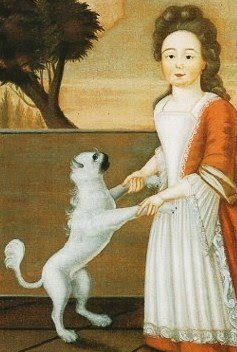 1710s Justus Engelhardt Kuhn (fl 1707-1717) Young Girl
 1715 Attributed to Charles Bridges (1670-1747). Child of Rev. Richard Chase (1692-1742) of London and Maryland, and his wife Margaret Frances Townley (d. 1741)
 1728 New York Depeyster Limmer. Depeyster Twins: Eva & Catherina.
 1730s Child of the Pierpont Family.
 c. 1735 Charles Bridges (1670-1747). Anne Byrd.
 1720s-30s Gerardus Duyckinck (1695-1746). Jacomina Winkler
 1755 John Singleton Copley (1738-1815). The Gore Children.
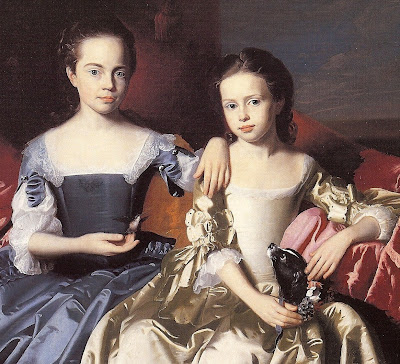 1758 John Singleton Copley (1738-1815). Mary MacIntosh Royall and Elizabeth Royall.
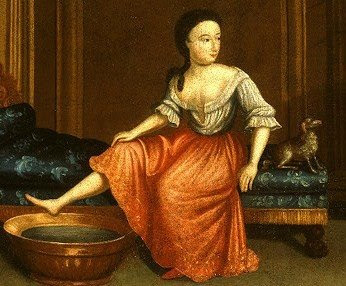 1730s Gerardus Duyckinck (1695-1746). Lady Undressing for a Bath.
 1730 John Simbert (1688-1751). Mrs Nathaniel Cunningham.
+Magdalen+Charlton+(Mrs.+Thomas+Dongan).+Museum+of+Fine+Arts,+Boston.jpg) C 1750 John Wollaston (1710-1775) Magdalen Charlton (Mrs. Thomas Dongan).
C 1750 John Wollaston (1710-1775) Magdalen Charlton (Mrs. Thomas Dongan).
.+Anne+Allen+(Mrs.+John+Penn)..jpg) c 1760 Benjamin West (1738-1820). Anne Allen (later Mrs. John Penn). John Penn (1729-1795) was the last governor of colonial Pennsylvania, serving from 1763-1771 & 1773-1776, & he was a grandson of William Penn. Portrait of the daughter of West's benefactor Chief Justice William Allen may have been painted as West was traveling from Pennsylvania to Italy and then to England.
c 1760 Benjamin West (1738-1820). Anne Allen (later Mrs. John Penn). John Penn (1729-1795) was the last governor of colonial Pennsylvania, serving from 1763-1771 & 1773-1776, & he was a grandson of William Penn. Portrait of the daughter of West's benefactor Chief Justice William Allen may have been painted as West was traveling from Pennsylvania to Italy and then to England.
 1760 English artist James McArdell (1728-1965) after Joshua Reynolds Joshua Reynolds (English Rococo Era Painter, 1723-1792).
 1763 John Singleton Copley (1738-1815) Mrs Jerathmael Bowers.
 1773 Gilbert Stuart (1755-1828). Christian Stelle Banister & Son John
 1787 Henry Benbridge (1743-1812). Hartley Family.
+Elizabeth+Davis+Mrs+Hezekiah+Beardsley+1749-1790+Yale+Univ+Art+Gallery1st-gallery-art.com.jpg) 1785-90 Beardsley Limner Possibly Sarah Bushnell Perkins (1771 - 1831). Elizabeth Davis (Mrs Hezekiah Beardsley).
1785-90 Beardsley Limner Possibly Sarah Bushnell Perkins (1771 - 1831). Elizabeth Davis (Mrs Hezekiah Beardsley).
 1789 - 1791 Payne Limner. Martha Payne.
During the 17th century in colonial America, life for a dog could prove tenative, especially during the Salem witch trials. From June to September in 1692, 156 people were accused; fourteen women, five men and two dogs were hanged--children accused the dogs of giving them the "evil eye."
However, soon the expanding love of humans for canines was endorsed by 18th philosophers, playwrights, and poets. Voltaire wrote,
"the best thing about man is the dog." Alexander Pope declared that
"histories are more full of examples of fidelity of dogs than of friends." And Robert Burns wrote that
"the dog puts the Christian to shame." In the colonies in 1738, Benjamin Franklin wrote,
"There are three faithful friends—an old wife, an old dog, and ready money."In Williamsburg and its environs, the
Virginia Gazette often carried advertisements for lost dogs. In 1751, Alexander Finnie, who ran the Raleigh Tavern, offered to pay
"Half a Pistole" to anyone who returned his "spaniel BITCH, with white and brown spots." In 1752 Williamsburg, a pet dog
Ball, a reddish spaniel was lost, and his owner James Spiers was willing to part with a dollar to get him back. In 1774,
Glasgow, a brown-and-white bulldog with an iron collar, had gone missing and his owner offered 20 shillings for his return. In the same paper in 1777, a pet black Pomeranian called
Spado was stolen and a $20 reward was offered.
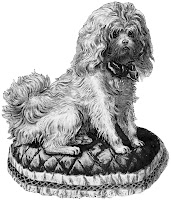
In the only connection between dogs and women that I have found yet---in 1775, Williamsburg's
Virginia Gazette printed
"On the Death of a Lady's Dog" Thou, happy creature, art secure From all the troubles we endure.
.
+Nat+Gal+Art1st-gallery-art.com.jpg) 1788 Ralph Earl (1751-1801). Martha Tennent (Mrs David Rogers) and Daughter.
1788 Ralph Earl (1751-1801). Martha Tennent (Mrs David Rogers) and Daughter. 1790 Ralph Earl (1751-1801). Mary Floyd (Mrs. Benjamin Tallmadge) with Son Henry Floyd and Daughter Maria Jones.
 1790 Ralph Earl (1751-1801). Abigail Starr (Mrs. William Taylor) and Son Daniel.
 1791 Ralph Earl (1751-1801). Mrs. William Moseley and Son Charles.
 1793 Ralph Earl (1751-1801). Sarah McCurdy (Mrs. Henry Channing) and Son Henry William
 1796 Ralph Earl (1751-1801) Mrs Elijah Boardman and Son
+(1601-1673)+Child+and+Sheep,+1655.jpg)
+Lady+Belasyse.jpg)
++Girl+with+a+Lamb+(2).jpg)
+Self+Portrait.jpg)
+Portrait+of+a+Woman+as+St+Agnes+traditionally+identified+as+Catherine+Voss.jpg)
+Portrait+of+Henrietta+Duchess+of+Bolton.jpg)
+De+Peyster+Girl+with+Lamb.jpg)
+Portrait+Of+Franks+Children+with+Lamb+1735.jpg)
+Mary+Sylvester.jpg)
+Elizabeth+and+Mary+Chichester.jpg)
+Girl+with+a+Lamb.jpg)
++Mary+Beekman.jpg)
++Miss+Frances+Warren.jpg)
+Miss+Frances+Warren.jpg)
.jpg)
++Baptist+Noel+4th+Earl+of+Gainsborough+and+His+Wife+Elizabeth+with+their+Children.jpg)

 1710s Justus Engelhardt Kuhn (fl 1707-1717) Young Girl
 1715 Attributed to Charles Bridges (1670-1747). Child of Rev. Richard Chase (1692-1742) of London and Maryland, and his wife Margaret Frances Townley (d. 1741)
 1720s-30s Gerardus Duyckinck (1695-1746). Jacomina Winkler
 1758 John Singleton Copley (1738-1815). Mary MacIntosh Royall and Elizabeth Royall.
 1730s Gerardus Duyckinck (1695-1746). Lady Undressing for a Bath.
.+Rebecca+Orne+(later+Mrs.+Joseph+Cabot).+Worcester+Museum+of++Art..jpg)
+pvt1st-gallery-art.com.jpg)

.+Girl+with+a+Squirrel..jpg)


