Jumat, 08 Juni 2012

PAINTER OF GENRE SCENES AND LANDSCAPES


Much like their seventeenth century counterparts, a group of painters known as the Hague School in the 1870s came to embrace as their subject matter the native Dutch landscape and the everyday lives of its rural inhabitants, most notably the fisher folk of the coastal villages. Within ten years the Hague School artists’ works would prove so popular that incredibly a mania for all things Dutch would be felt throughout the world, and would dominate the art in Holland until well after the turn of the century. By embracing simple themes remarkable for their ordinariness, the Hague School succeeded in striking a chord with a public whose own placidity was constantly being rattled by the evolving modernity of the times. Conveyed through the employment of subtle tones, hazy skies and subjects of happenstance their mix of nostalgia and realism enchanted viewers. The Hague became the center of the movement because it was semi-rural surrounded by meadows, polders, waterways, dunes and woods, and nearby Scheveningen provided a wealth of material for artists seeking to paint the shore and its fishing community.
(steigrad.com)
Frederik Hendrik Kaemmerer spent the greater part of his life living and working in Paris. He specialized in painting landscapes, later turning to genre paintings in an 18th century French setting. He achieved particular success with his depictions of elegant ladies. His contemporaries idealized the 18th century as a period of luxury, refinement and courteous behavior. (simonis-buunk.com) A student of Jean Leon Gerôme, Frederik Hendrik Kaemmerer (born 1839 - died 1902) divided his time between Paris and the place of his birth, La Haye. His early works were often small, highly finished canvases of late 18th-and early 19th-century anecdotal history subjects.
(askart.com)


The lady in red
From onokart.wordpress.com


'Junge Dame am Kamin'
Source Hampel Auctions
From commons.wikimedia.org


Beach at Scheveningen Holland
From wikipedia.org


Elegant ladies at the Scheveningen beach
From simonis-buunk.com


The Beach At Scheveningen Holland

An Afternoon of Fishing
Images from xaxor.com


A Winter Escapade
From artmight.com


Frederik Hendrik Kaemmerer exhibited at the Paris Salon from 1870 onwards; he was awarded a medal in 1874 and a silver medal at the Exposition Universelle of 1889. He was made Chevalier of the 'Légion d'Honneur' that same year. He achieved great success with his small, highly polished pictures of subjects under the Directoire and the First Empire. He sought to please the public at large and his marvelous paintings were much sought after by his American clientele. Towards the end of his life his style became freer and he demonstrated a speed of execution that allies him with the Impressionists. (artfinding.com) Frederik Hendrik Kaemmerer Biography: 1839 Born 1865 Moved to Paris and studied with Jean-Leon Gerome (1824-1904) 1874 Obtained a medal from the Paris Salon 1899 Silver medal at the Universal Exposition 1899 Received the most prestigious Legion of Honor 1902 Died Selected Exhibitions: 1893 Arnheim 1870 Paris Salon 1864 Rotterdam 1861 - 1863 The Hague.
(artnet.com)


PAINTER OF GENRE SCENES AND LANDSCAPES


Much like their seventeenth century counterparts, a group of painters known as the Hague School in the 1870s came to embrace as their subject matter the native Dutch landscape and the everyday lives of its rural inhabitants, most notably the fisher folk of the coastal villages. Within ten years the Hague School artists’ works would prove so popular that incredibly a mania for all things Dutch would be felt throughout the world, and would dominate the art in Holland until well after the turn of the century. By embracing simple themes remarkable for their ordinariness, the Hague School succeeded in striking a chord with a public whose own placidity was constantly being rattled by the evolving modernity of the times. Conveyed through the employment of subtle tones, hazy skies and subjects of happenstance their mix of nostalgia and realism enchanted viewers. The Hague became the center of the movement because it was semi-rural surrounded by meadows, polders, waterways, dunes and woods, and nearby Scheveningen provided a wealth of material for artists seeking to paint the shore and its fishing community.
(steigrad.com)
Frederik Hendrik Kaemmerer spent the greater part of his life living and working in Paris. He specialized in painting landscapes, later turning to genre paintings in an 18th century French setting. He achieved particular success with his depictions of elegant ladies. His contemporaries idealized the 18th century as a period of luxury, refinement and courteous behavior. (simonis-buunk.com) A student of Jean Leon Gerôme, Frederik Hendrik Kaemmerer (born 1839 - died 1902) divided his time between Paris and the place of his birth, La Haye. His early works were often small, highly finished canvases of late 18th-and early 19th-century anecdotal history subjects.
(askart.com)


The lady in red
From onokart.wordpress.com


'Junge Dame am Kamin'
Source Hampel Auctions
From commons.wikimedia.org


Beach at Scheveningen Holland
From wikipedia.org


Elegant ladies at the Scheveningen beach
From simonis-buunk.com


The Beach At Scheveningen Holland

An Afternoon of Fishing
Images from xaxor.com


A Winter Escapade
From artmight.com


Frederik Hendrik Kaemmerer exhibited at the Paris Salon from 1870 onwards; he was awarded a medal in 1874 and a silver medal at the Exposition Universelle of 1889. He was made Chevalier of the 'Légion d'Honneur' that same year. He achieved great success with his small, highly polished pictures of subjects under the Directoire and the First Empire. He sought to please the public at large and his marvelous paintings were much sought after by his American clientele. Towards the end of his life his style became freer and he demonstrated a speed of execution that allies him with the Impressionists. (artfinding.com) Frederik Hendrik Kaemmerer Biography: 1839 Born 1865 Moved to Paris and studied with Jean-Leon Gerome (1824-1904) 1874 Obtained a medal from the Paris Salon 1899 Silver medal at the Universal Exposition 1899 Received the most prestigious Legion of Honor 1902 Died Selected Exhibitions: 1893 Arnheim 1870 Paris Salon 1864 Rotterdam 1861 - 1863 The Hague.
(artnet.com)

Senin, 04 Juni 2012

THE GRANDEUR OF LESS FREQUENTLY DEPICTED LOCATIONS


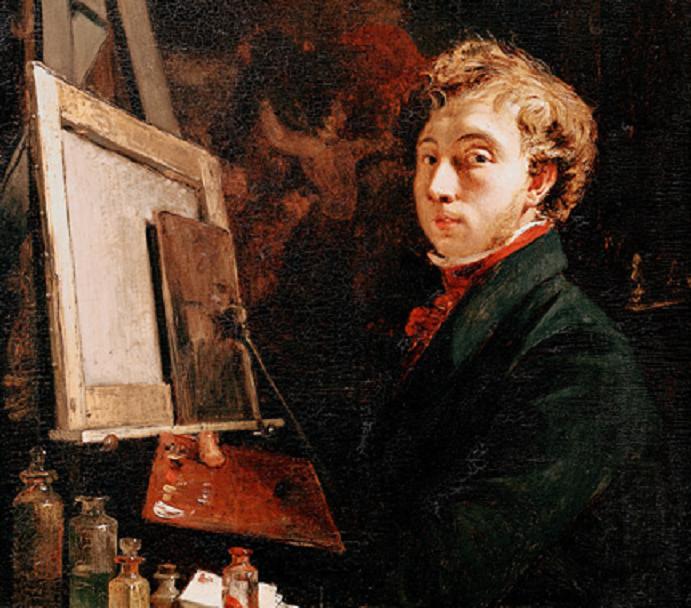
Richard Parkes Bonnington
Self Portrait
Photo Bridgeman Art Library, London
From nationalgallery.org.uk


Born of English parents, Richard Parkes Bonnington (Arnold near Nottingham 1802-1828 London) spent much of his short life in France. He studied initially in Calais with Louis Francia before moving to Paris. In 1818 he first met Eugène Delacroix and enrolled in the atelier of Baron Antoine-Jean Gros, where he formed a lasting friendship with Paul Huet, a fellow pupil. He was one of the stars of the 1824 Paris Salon, where British art was so triumphant, and along with John Constable and Copley Fielding received a gold medal. Bonington was an inveterate traveler and spent much time exploring the north coast of France. In 1825 he visited London with several French artists, including Delacroix, and in 1826 he travelled through Switzerland to Venice. He was one of the most important artists of the early nineteenth century, vital to the understanding of French and British art of the Romantic period. His range included history and subject paintings, and landscapes, highly-finished works and sketches, all imbued with a brilliance and sureness of touch which was greatly admired both during and after his lifetime. (nationalgallery.org.uk)


The Rialto, Venice
From wikipaintings.org


The Giudecca in Venice
From fondationcustodia.fr


This extremely loose and sketchy view of Venice appears to have been painted from the water. ‘A gloriously sunny painting,’ as Frits Lugt described it in the inventory. The low horizon and the superb way the water and the sky merge are quite remarkable. Bonington was in Venice from 4 April to 20 June 1826 and in this time he made a group of similar studies, all on the same English board. It is typical of Bonington that in these studies he manages to bring out the grandeur of less frequently depicted locations.
(From fondationcustodia.fr)


A Boat Beached in a Port at Low Tide
From wikipaintings.org


‘Die normanische Küste’
Current Loc Musée du Louvre
From fr.wikipedia.org


‘Seestück’
From ceansbridge.com


‘La Ferté’
From nationalgallery.org.uk


The site of this fresh and immediate sketch has been cautiously identified as that of La Ferté in the estuary of La Somme, on the Picardy coast. The north coast of France was frequently travelled by Bonington, and provided him with a wealth of subjects for his coast scenes. La Ferté and nearby St.Valèry-sur-Somme were among his favorite haunts and those of his painting companions, Paul Huet and Thomas Shotter Boys. This work is a study made on the spot. The whole is quickly and fluidly painted, with the stretches of sand, sea and sky painted with broad horizontal sweeps of the brush. On the horizon vertical sweeps indicate rain showers. Certain details, such as the boat on the left and the small boat to the right in the distance are painted wet-in-wet, but others, such as the boat on the right and the figure of the woman were likely to have been added in the studio. (nationalgallery.org.uk)


Sunset in the Pays De Caux
Current Loc Wallace Collection
From commons.wikimedia.org


On The Coast Of Picardy

On The Adriatic
Images from xaxor.com


Distant View of St-Omer
Current Loc Tate Britain
From tate.org.uk


Bonington resided the greater part of his life in Paris. He made a few visits to England, and on the last occasion he was taken ill and died of consumption. He practiced at the Louvre and the Institut, and also received instruction from Baron Gros. His paintings, in oil and water colors, were almost entirely executed in France; he, however, made one visit to Italy. In Paris his works were chiefly architectural with street scenes, admirably executed, whilst his landscapes with fine atmospheric effects display great freedom in execution. It is somewhat remarkable that after Cotman and Bonington had, in the first part of the nineteenth century, developed a style so greatly appreciated at the present time, so many of the landscape painters in water colors in the early Victorian era should still have adhered to the old restricted methods. Constable exercised considerable influence on the French landscape painting in oil, whilst Bonington showed the French artists the capabilities of water colors, which they did not fail to appreciate.
(Project Gutenberg's Masters of Water-Colour Painting, by H. M. Cundall)


THE GRANDEUR OF LESS FREQUENTLY DEPICTED LOCATIONS


Richard Parkes Bonnington
Self Portrait
Photo Bridgeman Art Library, London
From nationalgallery.org.uk


Born of English parents, Richard Parkes Bonnington (Arnold near Nottingham 1802-1828 London) spent much of his short life in France. He studied initially in Calais with Louis Francia before moving to Paris. In 1818 he first met Eugène Delacroix and enrolled in the atelier of Baron Antoine-Jean Gros, where he formed a lasting friendship with Paul Huet, a fellow pupil. He was one of the stars of the 1824 Paris Salon, where British art was so triumphant, and along with John Constable and Copley Fielding received a gold medal. Bonington was an inveterate traveler and spent much time exploring the north coast of France. In 1825 he visited London with several French artists, including Delacroix, and in 1826 he travelled through Switzerland to Venice. He was one of the most important artists of the early nineteenth century, vital to the understanding of French and British art of the Romantic period. His range included history and subject paintings, and landscapes, highly-finished works and sketches, all imbued with a brilliance and sureness of touch which was greatly admired both during and after his lifetime. (nationalgallery.org.uk)


The Rialto, Venice
From wikipaintings.org


The Giudecca in Venice
From fondationcustodia.fr


This extremely loose and sketchy view of Venice appears to have been painted from the water. ‘A gloriously sunny painting,’ as Frits Lugt described it in the inventory. The low horizon and the superb way the water and the sky merge are quite remarkable. Bonington was in Venice from 4 April to 20 June 1826 and in this time he made a group of similar studies, all on the same English board. It is typical of Bonington that in these studies he manages to bring out the grandeur of less frequently depicted locations.
(From fondationcustodia.fr)


A Boat Beached in a Port at Low Tide
From wikipaintings.org


‘Die normanische Küste’
Current Loc Musée du Louvre
From fr.wikipedia.org


‘Seestück’
From ceansbridge.com


‘La Ferté’
From nationalgallery.org.uk


The site of this fresh and immediate sketch has been cautiously identified as that of La Ferté in the estuary of La Somme, on the Picardy coast. The north coast of France was frequently travelled by Bonington, and provided him with a wealth of subjects for his coast scenes. La Ferté and nearby St.Valèry-sur-Somme were among his favorite haunts and those of his painting companions, Paul Huet and Thomas Shotter Boys. This work is a study made on the spot. The whole is quickly and fluidly painted, with the stretches of sand, sea and sky painted with broad horizontal sweeps of the brush. On the horizon vertical sweeps indicate rain showers. Certain details, such as the boat on the left and the small boat to the right in the distance are painted wet-in-wet, but others, such as the boat on the right and the figure of the woman were likely to have been added in the studio. (nationalgallery.org.uk)


Sunset in the Pays De Caux
Current Loc Wallace Collection
From commons.wikimedia.org


On The Coast Of Picardy

On The Adriatic
Images from xaxor.com


Distant View of St-Omer
Current Loc Tate Britain
From tate.org.uk


Bonington resided the greater part of his life in Paris. He made a few visits to England, and on the last occasion he was taken ill and died of consumption. He practiced at the Louvre and the Institut, and also received instruction from Baron Gros. His paintings, in oil and water colors, were almost entirely executed in France; he, however, made one visit to Italy. In Paris his works were chiefly architectural with street scenes, admirably executed, whilst his landscapes with fine atmospheric effects display great freedom in execution. It is somewhat remarkable that after Cotman and Bonington had, in the first part of the nineteenth century, developed a style so greatly appreciated at the present time, so many of the landscape painters in water colors in the early Victorian era should still have adhered to the old restricted methods. Constable exercised considerable influence on the French landscape painting in oil, whilst Bonington showed the French artists the capabilities of water colors, which they did not fail to appreciate.
(Project Gutenberg's Masters of Water-Colour Painting, by H. M. Cundall)


Jumat, 01 Juni 2012

Waving Goodbye

Blogger have just informed me that the old blogger interface is going shortly. My health is not good most days and I can't struggle with the new interface that doesn't format properly, schedule properly and who's only good thing seems to be to re size pictures better. And don't start me on the horrible new verification.

I know a lot of you don't like Facebook, but its easier than this load of codswallop. Have a happy life, I am not going to spend the time I have left, fighting Blogger.

Just a point - google doesn't seem to index fb entries and photographs, so I'll have to think about tumblr or pininterest.

I can only apologise but enough is enough for me. I loved Blogger when I started.

Phillip Brown

Kamis, 31 Mei 2012

Victorian paints


A Victorian bladder of paint before tubes were invented. Some artists preferred glass jars. The bladders would have been made from pig membrane and tied at the top with strong twine to exclude air. Artists had a wide choice of pigments that came from minerals, precious stones, rocks, vegetables, insects and plants. Some of the new colours he used came about by the advances of modern chemistry. He used: lead white, zinc white, ultramarine ash, vermilion, chromium oxide, zinc yellow, chrome yellow, cobalt blue, Prussian blue, burnt sienna, Naples yellow, madder lake, ivory black and bone black. Greens were mixed greens of chrome yellow and Prussian Blue, possibly from a tube of green paint.

Artists would have mixed their oil paint (a mixture of pigment and oil) with another liquid to make the pigment more fluid and transparent. This liquid is called the medium and a common one used was copal medium, a resin (a sticky substance produced by trees) dissolved in oil (see image) to make the paint more fluid.

Before the introduction of ready-made paint, artists had to mix paint themselves.

Victorian cricket icon for sale


http://www.artdaily.org/index.asp?int_sec=2&int_new=55721

Popular Posts