Tampilkan postingan dengan label Primary Source. Tampilkan semua postingan

Sabtu, 17 September 2011

Biography - Baltimore Postmistress & Publisher Mary Katherine Goddard 1738-1816 & Her Rude Dismissal by George Washington

.

Mary Katherine Goddard (1738-1816) was the only daughter of Sarah Updike (1700-1770) & Dr. Giles Goddard (1703-1757), postmaster & physician in Groton & New London, Connecticut. Sarah taught her daughter & her younger son William (1740-1817) to write and read Shakespeare, Pope, & Swift among others. For more on Mary Katherine's outstanding mother, go here.

After serving as a printer’s apprentice in Connecticut, William Goddard decided to try his hand at publishing a newspaper with the help of his sister & mother. Their father had died in 1757, leaving an estate of 780 pounds sterling. In 1762, William began his publishing career in Rhode Island, creating the Providence Gazette and Country Journal by using 300 pounds given him by his mother to set up a printing press in Providence. Expecting to print lots of newspapers, in 1764, Goddard entered a partnership with 3 other gentlemen and used more of his father's estate to help establish & operate the 1st paper mill in Rhode Island on the Woonasquatucket River.

A year later, William Goddard became frustrated at his lack of financial success & gave up editorship of the Rhode Island newspaper. He claimed that 2 New York gentlemen "who wished to see me employed on a more extensive theatre" enticed him to leave Rhode Island. His practical mother & sister Mary Katherine kept publishing the Providence newspaper from 1765 through 1768; after all, they owned the printing press.

Before the Revolution, Goddard, who now had moved from New York to Philadelphia "to find a more adventageous situation," had to use private carriers to get news past the prying eyes of the English Crown post. After joining others to publish the Pennsylvania Chronicle and Universal Advertiser —a paper sympathetic to the revolutionary cause, the local Crown postmaster kept out-of-town newspapers from the press, depriving the publisher of critical news & information.

His mother, who had stayed in Providence operating the business she had paid for; finally sold the Providence press & followed him to Philadelphia with Mary Katherine. In Philadelphia, Sarah Goddard ran a bookstore until 1768, she died in 1770.

Mary Katherine published the Pennsylvania Chronicle and Universal Advertiser alone under her brother's name for the last year of its existence. Her erratic brother was too busy with politics to help in the everyday production. William was frequently jailed for public outbursts and rabble-rousing articles in the paper.

The Pennsylvania Chronicle and Universal Advertiser was driven out of business, when the Crown post refused to accept it for distribution in the mails. William Goddard retaliated politically by designing an American postal system founded upon the principles of open communication, no governmental interference, and free exchange of ideas.

Goddard presented his plan to the Continental Congress on October 5, 1774. The representatives were intrigued but tabled Goddard's plan; until the startling battles of Lexington & Concord in 1775. Soon after, on July 16, 1775, the new "Constitutional Post" was implemented by the Congress, ensuring communication between patriots & keeping the readers informed of events during the American Revolution. The new revolutionary post system forced the Crown post out of business in America on Christmas day, 1775, becoming the foundation of the United States' postal system.

Once again pulling up roots, Willliam Goddard decided to attempt a new printing venture in Baltimore. By early 1774, Mary Katherine, who had been helping her brother & mother with their bookstore, newspaper, almanac, and printing ventures, moved south to help her brother; as he began to publish a newspaper in Baltimore.

The Maryland Journal was established by William Goddard August 20, 1773, the first newspaper to be printed in Baltimore. Goddard published the paper with the help of his sister until May 10, 1775, when Mary Katherine Goddard, became the editor & publisher. Until 1784, the newspaper appeared solely under her name.

Because of the new postal system, newpapers could now flow between the colonies without censorship; but new problems arose, as the Revolutionary War created a paper shortage for publishers. The war also sparked inflation leaving subscribers with little cash. To keep her newspaper publishing regularly, Mary Katherine accepted barter in beef, pork, animal food, butter, hog’s lard, tallow, beeswax, flour, wheat, rye, Indian corn, beans and other goods she could either use or sell in her shop.

In 1775, Mary Katherine took an additional job at the Baltimore Post Office. She became the first woman postmistress in the colonies.

The First Post Office in Baltimore. Photo from the Maryland Historical Society, also located in Baltimore, Maryland.
Under Mary Katherine Goddard, the Maryland Journal openly expressed the colonials' thirst for freedom from the crown, although she was willing to take a risk and publish a variety of political perspectives. Mary Katherine published reports of Massachusetts of April 19, 1775, triggering the Battles of Concord and Lexington. Her editorial of June 14, 1775, proclaimed, "The ever memorable 19th of April gave a conclusive answer to the questions of American freedom. What think ye of Congress now? That day. . . evidenced that Americans would rather die than live slaves!"
During the lean years of the Revolution, Postmistress Mary Katherine Goddard opened a book & stationary store in Baltimore, and kept her printing press busy publishing books & almanacs as well as her newspaper.

In January 1777, she printed the first copy of the Declaration of Independence to include the signers' names, before any other newspaper in the United States. In the summer of 1776, the signers were aware that they were committing treason and submitting to an overabundance of caution, omitted their names from the original publication of the document. Six months later, finally garnering the courage to publicly stand by their professed ideals, the Continental Congress authorized Goddard’s Maryland Journal to publish the Declaration with its signers’ names.

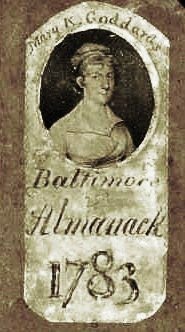
Mary Katherine Goddard's almanacs were also popular in the Chesapeake. In her 1782 Maryland and Virginia Almanack, Mary Katherine wrote, "From the extensive sale of this Almanack last year, the publisher would presume to think that her endeavors, in some measure, met with the approbation of the Public. Nothing can be more flattering than this idea, which cannot fail to excite in her the highest sense of gratitude, attended with future diligence and perseverance."

After he married, her mercurial brother decided that he wanted to return to the Baltimore publishing business and to run the newspaper and the press himself in 1784. He had never been successful at any occupation and was jealous of his sister's success. Wrenching control of the press was not without turmoil. Mary Katherine Goddard filed 5 lawsuits against her brother before severing her interest in the printing enterprise, which she had successfully managed for 10 years. After all, she still had her position as Baltimore's postmistress to rely on for income.

However, in September 1789, Samuel Osgood, the newly appointed national Postmaster General, decided that inexperienced political appointee John White of Baltimore should replace Goddard. The Assistant Postmaster General Jonathan Burrall was dispatched to Baltimore to give Mary Katherine Goddard the news; but unable to face her in person, he sent a note to her office. She was ordered to turn over her office to White, and told, "a younger person able to ride a horse" was needed.

Over 200 merchants & residents in Baltimore sent a petition and letters objecting to her removal to the Postmaster General. They received no reply. Believing she was still capable at age 51; just before Christmas, she wrote to President George Washington to have the order reversed. She wrote the letter in the 3rd person.

Baltimore, Decemr 23d 1789.
Dear Sir,


The Representation of Mary Katherine Goddard, Humbly sheweth--That She hath kept the Post Office at Baltimore for upwards of fourteen years; but with what degree of Satisfaction to all those concerned, She begs leave to refer to the number & respectability of the Persons who have publickly addressed the Post Master General & his Assistant, on the Subject of her late removal from Office; And as Mr Osgood has not yet favoured between two and three hundred of the principal Merchants & Inhabitants of Baltimore with an answer to their last application, transmitted to him by Post on the last Day of November ultimo,
nor with any Answer to sundry private Letters, accompanying the transcript of a like application, made to Mr Burrell when at Baltimore: She therefore, at the instance of the Gentlemen thus pleased to interest themselves on her behalf, lays before your Excellency, Superintendant of that department, as briefly as possible, the nature & circumstances, of what is conceived to be an extraordinary Act of oppression towards her.

That upon the dissolution of the old Government, when from the non importation Agreement and other causes incident to the Revolution, the Revenue of the Post-Office was inadequate to its disbursements, She accepted of the same, and at her own risque, advanced hard money to defray the Charges of Post Riders for many years, when they were not to be procured on any other terms; and that during this period, the whole of her Labour & Industry in establishing the Office was necessarily unrewarded; the Emoluments of which being by no means equal to the then high Rent of an Office, or to the Attention required both to receive & forward the Mails, as will evidently appear by the Schedule, here unto annexed,
and therefore, whoever thus established & continued the Office, at the gloomy period when it was worth no Person's Acceptance, ought surely to be thought worthy of it, when it became more valuable. And as it had been universally understood, that no Person would be removed from Office, under the present Government, unless manifest misconduct appeared, and as no such Charge could possibly be made against her, with the least colour of Justice, She was happy in the Idea of being secured both in her Office, and the Protection of all those who wished well to the prosperity of the Post Office, & the new Government in general.

That She has sustained many heavy losses, well known to the Gentlemen of Baltimore, which swallowed up the Fruits of her Industry, without even extricating her from embarrassment to this day, although her Accounts with the Post Office were always considered, as amongst the most punctual & regular of any upon the Continent; notwithstanding which She has been discharged from her Office, without any imputation of the least fault, and without any previous official notice: The first intimation on that head being an Order from Mr Burrell,
whilst at Baltimore, to deliver up the Office to the Bearer of his Note; and altho' he had been there several days, yet he did not think proper to indulge her with a personal Interview, thus far treating her in the Stile of an unfriendly delinquent, unworthy of common Civility, as well as common Justice. And although Mr White, who succeeded her, might doubtless have been meritorious in the different Offices he sustained, yet, She humbly conceives, he was not more deserving of public notice & protection in his Station, than She has uniformly been in hers: It must therefore become a matter of serious Importance & of peculiar distress to her, if Government can find no means of rewarding this Gentleman's Services, but at the Expence of all that She had to rely on, for her future dependence & subsistence.

That it has been alledged as a Plea for her removal, that the Deputy Post Master of Baltimore will hereafter be obliged to ride & regulate the Offices to the Southward but that She conceives, with great deference to the Post Master General, this is impracticable, & morally impossible; because the business of the Baltimore Office will require his constant Attendance, & he alone could give satisfaction to the people, if therefore the duties of the Assistant, Mr Burrells' Office are to be performed by any other than himself, surely it cannot well be attempted by those who are fully occupied with their own; and as two Persons must be employed, according to this new Plan, She apprehends, that She is more adequate to give Instructions to the Riding Post Master, how to act than any other Person possibly could, heretofore unexperienced in such business.She, therefore, most humbly hopes from your Excellency's Philanthropy and wonted Humanity, You will take her Situation into Consideration; and as the Grievance complained of, has happened whilst the Post Office Department was put under your auspicious Protection, by a Resolve of Congress, that Your Excellency will be graciously pleased to order, that She may be restored to her former Office, and as in duty bound, She will ever pray &c.
Mary K: Goddard


George Washington promply responded.

New York January 6th.1790
Madam,

In reply to your memorial of the 10th of December, which has been received, I can only observe, that I have uniformly avoided interfering with any appointments which do not require my official agency: and the Resolutions and Ordinances establishing the Post Office under the former Congress, and which have been recognized by the present Government, giving power to the Post-Master General to appoint his own Deputies, and making him accountable for their conduct, is an insuperable objection to my taking any part in this matter.

I have directed your Memorial to be laid before the Post-Master General who will take such measures thereon as his Judgment may direct.

I am, Madam. Your Most Obedt. Servt. Go: Washington


Puffing himself up, Postmaster Samuel Osgood responded the next day giving no reason for the appointment of White except the following: "From mature Consideration, I am fully convinced that I shall be more benefitted from the Services of Mr White than I could be from those of Mrs Goddard."

After receiving Washington's dismissive letter, she pressed her appeal for reinstatement & for payment of a claim against the United States in both the Senate and House of Representatives. She was unsuccessful in obtaining either compensation or reinstatment.

The 1790 Maryland Census reported she owned four slaves and had one other free person living in her household. From 1790 to 1802, she operated a bookstore in Baltimore.

By the canvass of the 1810 Maryland Census, Mary Katherine Goddard was living with just one female slave in her household. Mary Katherine died in Baltimore in August of 1816, at the age of 78, leaving all her personal possessions & real property to her African American servant Belinda Starling & releasing her from slavery.
.

Newspaper - 1736 Runaway Woman - Maryland Indentured Servant

.

RAN away, on the 30th of September last, from the City of Annapolis, ...a Servant Woman, named Sarah Miers, a Dutch Woman, and talks broken English, pretty Tall, Round Shoulder'd. Likely in the Face, and had a Flat Nose: They took with them some Wearing Apparel, viz. a dark Grey Coat trimm'd with Black, a Woman's Blue Cloak, fac'd with White Silk; a Seesucker Gown, one White Linen Ditto; one strip'd Calimanco Ditto, a brown Camblet Petticoat, a Woman's Bermuda hat, lin'd with Blue Silk, and several other Things, viz. Bedding, Linnen, and in particular a Red Rugg. They went in an old carvil Work Long-Boat, with one Mast, and a Square Sail.

Virginia Gazette (Parks), Williamsburg, From Friday, October 8, to Friday, October 15, 1736.
.

Jumat, 16 September 2011

Newspaper - 1751 Runaway Love Triangle in Virginia

.

Stafford County, October 13th, 1751. RAN away from the Subscriber, this Day, a Servant Man, anmed William Frye...had on when he went away a bluish grey Kersey Coat, with yellow Buttons...The said Runaway went off with the Wife of the Subscriber, named Mary, a short, thick Woman of a dark Complexion, with black hair, black Eyes, aged about 30 Years, and has lost one of her front Teeth: She is a neat Woman in Sewing, Spinning, and knitting Stockngs, and can do almost any Manner of Taylors Work, but is oblig'd to use Spectacles when at Work. She took with her a striped Silk Stuff Gown...And, as the above-mentioned Mary has eloped from her said Husband, I hereby foreward all Persons from trusting her on my Account, for I will not pay any Debts she shall contract after the Publication hereof.

Virginia Gazette (Hunter), Williamsburg, October 31, 1751.
.

Newspaper - 1777 Army Deserter from the Revolution Runs Away with his Pregnant Wife

.
DESERTED from the 2d Virginia Regiment in New Jersey, the following ...Serjeant, 30 Years of Age...his Wife, who was heavy with Child, went off with him...the Serjeant...enlisted into Captain Alexander's Company, and may be taken in Frederick County, Virginia. ALEXANDER SPOTSWOOD, Col. 2d Virg. Reg.

Virginia Gazette(Dixon & Hunter), Williamsburg , September 5, 1777
.

Kamis, 15 September 2011

Newspaper - Virginia Runaway Slave Seamstresses

.

An unusual number of the slave seamstresses and house slaves appearing in Virginia runaway notices, were mulatto. The seamstresses had a variety of skills; while all were seamstresses, some were also described as being able to spin, weave, wash, and iron. Slaves, who were children of the master or his male relatives, were often raised to work in the house, closer to the family. Perhaps they were more likely to run away, because there was at least a chance that they could pass as white.

Below are slave notices for runaway seamstresses from a survey of most 18th century Virginia newspapers.

Virginia Gazette (Hunter), Williamsburg, October 27, 1752.
RAN away...a fair Mulatto Woman Slave, named Moll, about 22 Years of Age, and 5 Feet high, with brown Hair, grey Eyes, very large Breasts and Limbs two of her upper fore Teeth are rotten and broken off...she is a very sly subtle Wench and a great Lyar; she is very handy about waiting and tending in a House, and can wash, iron and sew coarse Work. It's likely she may change her Name, pass for a free Woman and hire herself...

Virginia Gazette (Purdie & Dixon), Williamsburg, September 8, 1768.
RUN away...a bright mulatto wench called LUCY... She sews and irons well, is about 35 years old, has two moles on one side of her nose, three of her fingers on one hand contracted by a burn when young, and a large scar on one of her elbows...

Virginia Gazette (Purdie & Dixon), Williamsburg, October 20, 1768.
RUN away...a bright mulatto wench named JUDE, about 30 years old, is very remarkable, has lost one eye, but which I have forgot, has long black hair, a large scar on one of her elbows, and several other scars in her face...I have great reason to think she will pass for a free woman, and endeavour to make into South Carolina. She is very knowing about house business, can spin, weave, sew, and iron, well...

Virginia Gazette (Purdie & Dixon), Williamsburg, May 6, 1773.
RUN away...a Country born Negro Woman named SARAH, a very lusty stout made Wench, about two and twenty Years of age, very artful, and, though not a Mulatto, may attempt to pass for a free Woman...She has been chiefly a House Servant, is a fine Sempstress, Knitter, Washer, and Ironer...

Virginia Gazette (Purdie), Williamsburg, February 21, 1777
...reward for taking up and delivering PATTY, a lightish coloured negro woman, pitted with the small pox, about 30 years of age, walks well, and generally fast, is rather above the middle size, well shaped, a good sempstress...

Virginia Gazette (Purdie), Williamsburg, August 8, 1777.
RUN away...a mulatto girl named KATE, or Catharine, about 5 feet high, has been brought up in the house from her infancy, and can work well with a needle. She is 19 or 20 years of age, has a smiling countenance when spoke to, and at some times is rather impertinent...

Virginia Journal and Alexandria Advertiser (Richards), Alexandria, October 21, 1784.
RAN away...CATE, a light Mulatto, about 22 years of age, about 5 feet high, full faced, expressive eyes, of a pleasant countenance, an high forehead, fine teeth, bushy long hair, is well set, and broad shouldered...She is very handy, spins well, and has been used to both house and plantation work. SINAH, about 20 years of age, rather of a darker complexion than Cate, has a sunken bumpy face, a very unbidding look, has a decay and holes in two of her upper foreteeth, a sulky illnatured countenance, well shaped, of the middle size, low forehead, and very bushy long hair...She has been brought up in the house, is a good seamstress, and spins well...

Virginia Journal and Alexandria Advertiser (Richards), Alexandria, September 29, 1785.
RAN AWAY...a MULATTO WOMAN, named MOLLY; of a middle size...As she can read, and is handy at her needle, it is probable she will endeavour to pass for a free woman. She is very artful, and capable of inventing a falsehood...

Virginia Independent Chronicle (Davis), Richmond, July 9, 1788.
RUN-AWAY ...a likely MULATTO WOMAN, called RACHEL; about 25 years of age, 5 feet 2 or 3 inches high, thin visage, long black hair, stoops in the shoulders, and has a scar (not very visible) on her chin, occasioned by the kick of a horse when a child. She is an excellent sempstress, and it is probable will pass (from being uncommonly white) for a free woman, unless closely observed...

Virginia Independent Chronicle (Davis), Richmond, March 13, 1790
.... a low, black, well set wench for a wife, the property of a Mr. James Toolers of Charles City, the wench is a decent house servant, can sew and wash very well

Virginia Gazette and General Advertiser
(Davis), Richmond, January 26, 1791
....She is about 40 years of age, and rather above the common stature, has a scar upon the back of her neck, and is a pretty good sempstress...

Virginia Gazette and General Advertiser (Davis), Richmond, January 18, 1792.
Committed to the jail of this county...a runaway negro wench who calls herself JAMIMAH, and says she belongs to a Mr. Robert Thompson of Louisa county. She appears to be about twenty years of age, very likely in person, above the middle size, strong, straight, of a very healthy and vigorous carriage, and remarkably handy in a family. She can sew plain work very well, is of a kind, obliging, obedient, soft disposition, with many marks on her back of having been severely and cruelly whipped indeed.

Norfolk Herald (Willett and O'Connor), Norfolk, May 13, 1797
....SLAVES left my residence...JAMES, A Mullato Man, about 30 years of age, ...The other slave is a dark mulatto woman called KESIAH, Wife to the above described man. She is a thin delicately formed woman, rather small, has short hair, with several grey bunches just appearing from under her cap on the from part of her head---her teeth before are decayed---She is much addicted to smoking tobacco, and is a great drunkard---She is between 30 and 40 years of age...Both these people have been bred to domestic capacities; the man is a house servant and to wait on a gentleman when travelling; the woman a lady's maid, and an excellent sempstress...

Alexandria Advertiser and Commercial Intelligencer (S. Snowden & Co.), Alexandria, May 7, 1802
....Ran Away...Patty, a likely Negro wench, about twenty years of age: she has been brought up in the house, is a good seamstress, & very capable...

Norfolk Herald (Willett and O'Connor), Norfolk, June 28, 1803
...eloped from me in August last. LUCY is about 40 years of age; rather spare made, has large eyes, and of a dark tawney complexion; I am told she can read, and perhaps write a little. She is an excellent seamstress, nurse &c...
.

Rabu, 14 September 2011

Newspaper - Runaway Slaves Who Could Read & Write

.

Virginia Journal and Alexandria Advertiser (Richards), Alexandria, September 29, 1785.
RAN AWAY...a MULATTO WOMAN, named MOLLY; of a middle size. She took with her two Virginia cloth jackets and petticoats, one brown and one green baize ditto, with sundry other things.---As she can read, and is handy at her needle, it is probable she will endeavour to pass for a free woman.

Virginia Gazette and General Advertiser (Davis), Richmond, August 24, 1791.
The following NEGROES...A MULATTO WOMAN went off with the above, who has since been been taken up at Norfolk, and as she can write, she probably has furnished the others with passes, changing thier name.

The Herald and Norfolk and Portsmouth Advertiser (Willett and O'Connor), Norfolk, November 9, 1795.
RUN AWAY...A likely mulatto woman named SILLAR, about the common stature, 25 years of age, and walks generally very brisk; she has been brought up a House Servant and can read a Letter...it is expected as she carried off her bed, bedding, and a number of good clothes, that she as been coaxed away by some free Negro or other, who has conveyed her off by water and intends to pass her as a free woman

Norfolk Herald (Willett and O'Connor), Norfolk, September 14, 1797.
Run away Negroes...JACK, a Carpenter by trade, about 40 years of age, 5 feet 9 or 10 inches high, of a dark complexion. PHEBE, his wife, and his daughter BETSEY, about 16 years of age, a very likely wench; also Two of the said Phebe's Children, one of which is 5 or 6 years and the other 6 months old. It is suspected Jack's wife will forge passes as she is very artful and can write...A Negro Fellow named Joe, son to the above Jack, about 20 years of age, plays on the Violin.

Norfolk Herald (Willett and O'Connor), Norfolk, October 2, 1800.
Negro Girl named NANCY, about 19 years of age, about 4 feet 4 inches, good stout looking girl; her complexion paler than general; had on when she went away a black new fashioned paste-board bonnet, trimmed with black ribbon, a blue handkerchief on her neck, dark callico short gown, purple worsted petticoat, she had a sifter in which she had cakes to sell about town...She has changed her name to BETSEY. Speaks very good Dutch, can read and write, and may forge herself a passport.

Norfolk Herald (Willett and O'Connor),Norfolk, October 29, 1801.
Forty Dollars Reward. RAN-AWAY from the subscriber, living in Petersburg, Virginia, in the afternoon of Thursday, the 22d inst. a likely spare made Negro Woman, named LUCINDA, (but sometimes she is called Lucinda Walker, and at other times Lucinda Brown) about 24 years of age, she is of the common height, and rather black: she has a remarkable pleasant countenance, smooth insinuating manners, and speaks very correct and distinct--she had previously sent off the most of her clothes in a trunk, (supposed marked at the bottom W.D. or W.I.D.) of which she has a variety of good materials and well made. I am informed she had made up just before her elopemont, a habit and coat of dark blue cloth in the fashion; and it is likely she will travel in that dress--she can both read and write a little: I am pretty certain that she has been enticed off by some bad designing man, probably white, and that she has through them procured free papers, or a pass of some kind which she will make use of. She was born and brought up in the family indulgently...expressing a desire to go to Europe.
.

Senin, 12 September 2011

Newspaper - Runaway House Slaves

.


Maryland Journal and Baltimore Advertiser (Goddard), Baltimore, June 27, 1780.
NEGROES, who ran away...Lucy, Hannah, and Nan...They are most of them very artful, and expect to pass as free people...Lucy's business has been to wash and iron. Young Hannah and Nan are exceeding good flax spinners. They are all mostly cloathed in Virginia cloth...They have stole some guns, and many different sorts of clothes, and I expect they will change their names.

Virginia Gazette (Clarkson & Davis), Richmond, August 19, 1780.
RUN away...a young mulatto wench named Sukey. Her dress when she went away was white Virginia cloth, a linen bonnet made in the fashion; she has a large bushy head of hair, her upper fore teeth much decayed, and some of them out, which causes her to lisp, shows her teeth when laughing, and is very brazen and impertinent. She can wash, iron, and cook.

Virginia Gazette and General Advertiser (Davis), Richmond, January 26, 1791.
RAN-AWAY...a large fat likely negro woman, known by the name of SARAH, but looks young to her age, which is between 40 or 50, of a bold insinuating countenance, artful and cunning to the highest degree...She is an excellent house servant, as to spinning cotton of flax, sewing, knitting, cooking, washing, or any thing else a wench can do, and can work very well in the crop--She is fond of making and selling ginger bread, &c. ...Her clothing when she went away was a large scarlet frize cloak, a hat dress with white ribbon and buckle, one callico jackcoat, one suit of green durants, sundry suits of strip'd and white Virginia cloth, and wore two silver rings on her fingers.

Virginia Herald and Fredericksburg Advertiser (Green), Fredericksburg, November 14, 1793.
RAN AWAY...in Orange county, the last of September, NEGRO MOLLY, a lusty likely woman, about 41 or 42 years of age, rather dark complexion; she is a healthy, neat, industrious wench, a good cook, washer and ironer, and is well acquainted with house business

American Gazette and Norfolk and Portsmouth Public Advertiser
(Davis), Norfolk, September 15, 1795.
RUN AWAY this morning, a negro Woman named MOLLY, But has of late gone by the name of BETTY...She is very black, has a bushy head, and remarkable white teeth, is about 5 feet 9 or 10 inches high, and supposed to be about 36 years of age; is a very good washer and ironer, and am informed a good cook, and is well acquainted with all kind of house business.

Norfolk Herald (Willett and O'Connor), Norfolk, August 2, 1800.
Negro Woman named PATTY...about 28 years of age, thick, well set, and about 5 feet 5 inches high. She has short curled hair, and prominent features, particularly eyes, noes, and mouth. Her teeth are bad and yellow, and the whites of her eyes are much affected by smoke. On her shoulders are two scars visible when she does not wear a handkerchief; and her right arm shews the marks of very frequent bleeding. Her voice is rather shrill; she is very talkative and disposed to be impertinent; but when it suits her purpose can assume every appearance of perfect humility. I expect she is in Norfolk, in company with a sister who bears a very striking resemblance...Patty is a good cook and washer, and probably will practice one or the other for a livelihood.

Norfolk Herald (Willett and O'Connor), Norfolk, March 12, 1801.
Run-a-way...Negro SAREY...well known in Norfolk as a negro hiring herself out to day's work at washing

Norfolk Herald (Willett and O'Connor), Norfolk, July 6, 1802
Ran Away...a tall, spare black woman named POLLY, about 20 years old, formerly the property of Major Roger West: she has been brought up to house-work, is a good cook, washer and nurse.

Sabtu, 10 September 2011

Newspaper - Runaway Slaves - Carders, Spinners, Weavers, & Knitters

.


Virginia Gazette (Hunter), Williamsburg, November 7, 1754.
RAN away...a Mulatto Wench, named Molly, about 26 Years of Age, of a middle Stature, long Visage, and freckled, has a drawling Speech, a down Look, and has been chiefly brought up to Carding and Spinning.

Virginia Gazette (Dixon & Hunter),Williamsburg, March 11, 1775.
RUN away... a very bright Mulatto Man named STEPHEN, 5 Feet 6 or 7 Inches high, about 22 Years of Age...His Wife PHEBE went away with him, a remarkable white Indian Woman, about the same Age, and was with Child; she has long black Hair, which is generally clubbed, and carried off with her a blue Negro Cotton Waistcoat and Petticoat, a Virginia Cloth Waistcoat and Petticoat, and a Virginia Cloth Bonnet. She can spin well...

Virginia Gazette or American Advertiser (Hayes), Richmond, February 2, 1782.
A black fellow by the name of PETER, frequently called PETER WOOD, about 37 or 38 years of age, 5 feet 8 or 9 inches high, has a smiling countenance...Also a very likely black girl, wife to the above fellow and taken off by him, about 18 or 19 years old, middle size, by the name of AMIA...She is a fine spinner and Weaver, has never had a child, and I am informed has holes in her ears for rings.Virginia Gazette or Weekly Advertiser (Nicolson & Prentis), Richmond, May 11, 1782.
VIOLET, went off about eight weeks ago, and is now harboured in Williamsburg, about twenty two years old, very likely, genteel made, and knits very well.

Virginia Gazette and Weekly Advertiser
(Nicolson & Prentis), Richmond, November 22, 1783.
RUN away...a negro girl named PHILLIS, but for some time passed by the name BETTY. She is about sixteen years of age, an excellent spinner, and very likely...She has for some time been harboured about Rocket's, and is very intimate and supposed lives with one Free Harry.

Virginia Gazette or American Advertiser (Hayes), Richmond, October 16, 1784.
RAN AWAY...a likely Mulatto woman named CHARITY, who carried with her three children, two boys and a girl...She is a likely wench, has an uncommon good voice, is a good house servant, and can spin and knit very well.

Virginia Gazette or American Advertiser (Hayes), Richmond, December 31, 1785
....my negro woman TABB. She is of a middle stature, rather of a yellowish cast, and thin visage, straight made, walks and talks quick...When she went off, she was clothed as Negroes generally are, which she will certainly change, being very fond of dress, and looks tolerable genteel. She is remarkable handy and industrious, can card and spin cotton and wool, equal in quantity and quality with any woman in the State; a tolerable good weaver, which she followed when she runaway before, and changed her name to Nancy Jones.

Virginia Gazette and Weekly Advertiser (Nicolson), Richmond, April 17, 1788.
RUN away...a stout well made Virginia born negro woman, named DINAH, but has changed her name to NANCY, her complexion is rather of the tawny kind, she has a scar on her forehead, and keeps her eyes rather closed when speaking, she chews tobacco, and smoaks...She last hired herself to Mrs. Jones, at Spring Garden, in Hanover, for a spinner and weaver, and had one of the house servants for her husband...

Virginia Gazette and General Advertiser (Davis), Richmond, January 18, 1792.
Run away...a likely negro woman, named URSULA, of a yellowish complexion, with some black moles on her face, 30 years of age, 5 feet three or 4 inches high, had on, when she went away, such cloathing as negroes generally wear in the summer, and carried with her a white linen coat and jacket. She is a vile creature, and for her many crimes I punsihed her with an iron collar, but supposed she soon got that off. She is very artful, has a smooth tongue, and is a good weaver, and as she has for some time imposed on the Baptist church by her pretensions to religion, she may probably attempt to pass for a free woman, and do the same again.
.

Jumat, 01 Juli 2011

The Earliest 4th of July Celebrations

.
On July 3, 1776, John Adams wrote to his wife Abigail,

The second day of July, 1776, will be the most memorable epoch in the history of America. I am apt to believe that it will be celebrated by succeeding generations as the great anniversary festival. It ought to be commemorated as the day of deliverance, by solemn acts of devotion to God Almighty. It ought to be solemnized with pomp and parade, with shows, games, sports, guns, bells, bonfires, and illuminations, from one end of this continent to the other, from this time forward forever more.


While John Adams may have chosen the wrong day, he certainly predicted how Americans would come to celebrate the day that the states of the union declared their independence from England. In fact, celebrations of the Declaration of Independence began soon after its signing and long before freedom had been secured.

Christopher Marshall wrote in his diary from Philadelphia on July 6, 1776, the King's arms there are to be taken down by nine Associators, here appointed, who are to convey it to a pile of casks erected upon the commons, for the purpose of a bonfire, and the arms placed on the top.


On July 8, 1776, Marshall reported that he went to State House Yard, where, in the presence of a great concourse of people, the Declaration of Independence was read by John Nixon. The company declared their approbation by three repeated huzzas. The King's Arms were taken down in the Court Room, State House same time...Fine starlight, pleasant evening. There were bonfires, ringing bells, with other great demonstrations of joy upon the unanimity and agreement of the declaration.

As the news spread throughout the colonies, other celebrations took place. The Virginia Gazette of July 26, 1776 which was published in Williamsburg reported that most of the townsfolk were joyful on July 25, 1776, when the Declaration of Independence was read aloud for all to hear "at the Capitol, the Courthouse, and the Palace, amidst the acclamations of the people." Citizens in Williamsburg celebrated even further with a military parade and the firing of cannon and muskets.


The Gazette also reported that in July of 1776 in Trenton, New Jersey, at a gathering of the militia & citizens: "The declaration, and other proceedings, were received with loud acclamations"

In New York, the "Declaration of Independence was read at the head of each brigade of the continental army posted at and near New York, and every where received with loud huzzas and the utmost demonstrations of joy...the equestrian statue of George III" in New York City was torn down. The Virginia Gazette reported that the lead from the monument would be turned into bullets for upcoming battles.


In one short but bloody year, the 4th of July celebration in Philadelphia had grown considerably. A newpaper account described the 1777 event,

Yesterday the 4th of July, being the Anniversary of the Independence of the United States of America, was celebrated in this city with demonstration of joy and festivity.


About noon all the armed ships and gallies in the river were drawn up before the city, dressed in the gayest manner, with the colours of the United States and streamers displayed. At one o'clock, the yards being properly manned, they began the celebration of the day by a discharge of thirteen cannon from each of the ships, and one from each of the thirteen gallies, in honour of the Thirteen United States.


In the afternoon an elegant dinner was prepared for Congress, to which were invited the President and Supreme Executive Council, and Speaker of the Assembly of this State, the General Officers and Colonels of the army, and strangers of eminence, and the members of the several Continental Boards in town.


The Hessian band of music taken in Trenton the 26th of December last, attended and heightened the festivity with some fine performances suited to the joyous occasion, while a corps of British deserters, taken into the service of the continent by the State of Georgia, being drawn up before the door, filled up the intervals with feux de joie.


After dinner a number of toasts were drank, all breaking independence, and a generous love of liberty, and commemorating the memories of those brave and worthy patriots who gallantly exposed their lives, and fell gloriously in defence of freedom and the righteous cause of their country.


Each toasts was followed by a discharge of artillery and small arms, and a suitable piece of music by the Hessian band. The glorious fourth of July was reiterated three times accompanied with triple discharges of cannon and small arms, and loud huzzas that resounded from street to street through the city.


Towards evening several troops of horse, a corps of artillery, and a brigade of North Carolina forces, which was in town on its way to join the grand army, were drawn up in Second street and reviewed by Congress and the General Officers.


The evening was closed with the ringing of bells, and at night there was a grand exhibition of fireworks, which began and concluded with thirteen rockets on the commons, and the city was beautifully illuminated.


Every thing was conducted with the greatest order and decorum, and the face of joy and gladness was universal. Thus may the 4th of July, that glorious and ever memorable day, be celebrated through America, by the sons of freedom, from age to age till time shall be no more. Amen, and amen. (Virginia Gazette, 18 July 1777 Published in Williamsburg. )


A much less elaborate but heartfelt celebration took place a year later. In the midst of the Revolutionary War on July 4, 1778, at his headquarters in New Brunswick, New Jersey, General George Washington directed his army to put "green boughs" in their hats; issued them a double allowance of rum; and ordered a Fourth of July artillery salute.

Throughout the Revolution, men & women spontaneously celebrated the signing of the Declaration of Independence on July 4th, before it became an officially sanctioned holiday at the end of the war. In 1781, the Massachusettes Legislature resolved to have the 1st official state celebration of the Fourth.

Boston was the first municipality to designate July 4th as a holiday, in 1783. In the same year, Alexander Martin of North Carolina was the first governor to issue a state order for celebrating the independence of the country on the Fourth of July.

Other proclamations by governors included Governor William Livingston of New Jersey who declared on July 4, 1787, that "the present day naturally recalls to our minds an event that ought never to be forgotten, and the revival of the military spirit amongst us, affords a happy argument of our determined resolution to maintain under the auspices of heaven, that glorious independence, the anniversary of which it has pleased God to preserve our lives this day to celebrate" (Pennsylvania Packet, and Daily Advertiser, 14 July 1787)

1776- The Pennsylvania Evening Post is the first newspaper to print the Declaration of Independence, on 6 July 1776; the Pennsylvania Gazette publishes the Declaration on 10 July and theMaryland Gazette publishes the Declaration on 11 July; the first two public readings of this historic document include one given by John Nixon on 8 July at Independence Square, Philadelphia, and another on the same day in Trenton; the first public reading in New York is given on 10 July; the first public readings in Boston and Portsmouth, N.H., take place on 18 July; three public readings take place on the same day (25 July) in Williamsburg; a public reading in Baltimore takes place on 29 July; in Annapolis on 17 August at a convening of the convention, "unanimous" support of the tenets of the Declaration are expressed

1777- At Portsmouth, N.H., Americans are invited by Captain Thompson to lunch on board a Continental frigate; in Philadelphia, windows of Quakers' homes are broken because Quakers refuse to close their businesses on holidays that celebrate American military victories; the first religious sermon about Independence Day is given by Rev. William Gordon in Boston before the General Court of Massachusetts

1778- From his headquarters in New Brunswick, N.J., General George Washington directs his army to put "green boughs" in their hats, issues them a double allowance of rum, and orders a Fourth of July artillery salute; at Princeton, N.J., an artillery salute is fired from a cannon taken from Burgoyne's army; in Philadelphia, guns and "sky rockets" are fired, but candles are not used for illuminations due to their scarcity; at Passy, France, John Adams and Benjamin Franklin host a dinner for "the American Gentlemen and ladies, in and about Paris"; the first Independence Day oration is given by David Ramsay in Charleston, S.C. before "a Publick Assembly of the Inhabitants"; on Kaskaskia Island, Ill., George Rogers Clark rings a liberty bell as he and his Revolutionary troops occupy Kaskaskia (under British rule) without firing a shot; at Mill Prison, near Plymouth, England, Charles Herbert (of Newburyport, Mass.) and other captured American prisoners of war celebrate the Fourth of July by attaching home-made American flags to their hats which they wear the entire day

1779- The Fourth falls for the first time on a Sunday and celebrations take place on the following day, initiating that tradition; in Boston, continental ships fire a "grand salute" from their cannons; in Philadelphia, although 14 members of the Continental Congress object to having a celebration, an elegant dinner at the City Tavern, followed by a display of fireworks, is given.

1781- The first official state celebration as recognized under resolve of a legislature occurs in Massachusetts; at Newport, R.I., the militia hosts French officers at a celebration dinner

1782- At Saratoga, N.Y., the "officers of the Regement" of the Continental Army celebrate with toasts and a "volley of Musquets at the end of each"

1783- Alexander Martin of North Carolina is the first governor to issue a state order (18 June) for celebrating the Fourth and the Moravian community of Salem responds with a special service and Lovefeast; Boston is the first municipality to designate (by vote on 25 March) July 4 as the official day of celebration; the governor of South Carolina gives a dinner at the State House in Charleston and at the celebration there, 13 toasts are drank, the last one accompanied by artillery guns firing 13 times and the band playing a dirge lasting 13 minutes

1786- In Beaufort, N.C., the Court House burns down, the result of an errant artillery shell during a celebration there

1787- John Quincy Adams celebrates the Fourth in Boston where he hears an oration delivered at the old brick meeting house and watches no less than six independent military companies process

1788- Fourth celebrations first become political as factions fight over the adoption of the Federal Constitution; pro- and anti-Constitution factions clash at Albany, N.Y.; in Providence, R.I., an unsuccessful attempt is made by 1,000 citizens headed by William Weston judge of the Superior Court, on July 4, to prevent the celebration of the proposed ratification of the Constitution; in Philadelphia, a "Grand Federal Procession," the largest parade in the U.S. to date, occurs under the planning of Francis Hopkinson; in Marietta, Ohio, James M. Varnum delivers the first Independence Day oration west of the Alleghany Mountains, in what was then known as the Northwestern territory

1791- The only Fourth of July address ever made by George Washington occurs at Lancaster, Pa.

1792- In Washington, a cornerstone for the "Federal Bridge" is laid by the Commissioners of the Federal Buildings

1794- Forty Revolutionary War soldiers celebrate near Nicholasville, in Jessamine County, Kentucky, at the home of Colonel William Price

1795- A mock battle engagement with infantry, cavalry and artillery units occurs in Alexandria, Va.; in Boston, the cornerstone for the Massachusetts State House is laid by Paul Revere and Gov. Samuel Adams

1796- In Baltimore, the Republican Society meets at Mr. Evan's Tavern

1798- George Washington attends the celebration in Alexandria, Va., and dines with a large group of citizens and military officers of Fairfax County there; in Portsmouth, N.H., the keel of the 20-gun sloop of war Portsmouth is laid

1799- The "musical drama," The Fourth of July or, Temple of American Independence (music by Victor Pelissier?), is premiered in New York; George Washington celebrates in Alexandria, Va. by dining with a number of citizens at Kemps Tavern there.

Thank you to James R. Heintze, American University, Washington DC. for his tireless research on the hisory of the 4th of July, which he shares online & in his books. 
.

18th-Century American Women Present Flags & Banners to Soldiers on the 4th of July

.
Although privileged young American women in the 18th-century often received elocution lessons, speaking in a public forum was generally left to men. Occasionally, women found opportunities to speak. The 4th of July was one of these occasions.

Presenting flags & banners to their local militia was a popular form of expression of patriotism by women in early America providing them the opportunity to express their sentiments regarding the importance of liberty & freedom. In an article titled “Spirit of the Ladies!” published by the editor of the Gazette in Portland, Maine, on 16 July 1798, 1, the role of women as an inspiration to the men serving their country was expressed:

"The American Fair, add much to the spirit of the times. In different parts of the Union they have presented the American standard to the Volunteer corps. This must have a charming influence to animate the breasts of our young soldiers. The idea of acting under the standard of our country, thus presented, with a reliance on our bravery, will excite the utmost vigor of our nerves, and inspire us with an honorable pride, that will never suffer them to be torn from our hands. Yes, ye fair! these sacred pledges of your patriotism must be maintained; and the sons of Columbia will no longer merit your favors, than they are ready and able to defend and protect you, and their country."

On July 4, 1798, Sally Duane presented a standard & addressed Macpherson’s Blues in Philadelphia.

"To General Macpherson: Impelled by far more laudable considerations than a desire to distinguish myself, permit me, through you, to present to the corps, under your command, a standard, which I hope they will deem worthy their acceptance, from the motives inducing the tender, however imperfect may be the execution of the work. Although ardently attached to the state in which I was born, from habits of early affection, yet patriotism extends my best wishes to all the meritorious citizens of our nation. Thos composing your corps are among the first who, by their exemplary virtue, have entitled themselves to the gratitude of every heart warmed with the love of our common country; and from whom should they receive more sincere testimonies of our approbation than from those of our sex? On the bravery of yours, we depend for protection. We can only oppose with our prayers, or indignantly, though fruitlessly, bewail with our tears, national insults or misfortunes. By your spirit and prowess, under the protection of Heaven, you can avert or avenge them. The art in which I am receiving instruction for amusement, cannot be employed to better purpose than in endeavours to decorate the ensigns devoted to merit and to patriotism. Happy shall we all be, if the art you are now learning be acquired merely as a necessary part of the education of free citizens, determined to defend their liberties and their laws. I fervently pray the Benign Disposer of the fate of nations to avert the hard necessity of its being brought into practice. Should he permit the angel of destruction to fill up the measure of their iniquities by guiding to our peaceful shores the enemies of our happiness, and of the peace and tranquility of the world, I shall tremblingly deprecate the occasion; but I confidently anticipate a consolation under so cruel a calamity, in the glory you and the rest of my fellow citizens will achieve, when before the foes of our beloved country, this banner shall be unfurled."
See: Claypoole’s Daily American Advertiser, 10 July 1798, 2; New York Gazette,12 July 1798, 3; Spectator, 14 July 1798, 4; Salem Gazette, 17 July 1798, 3; Newburyport Herald, 24 July 1798, 208; Connecticut Gazette, 8 August 1798, 1.

In the same year, the Newport, Rhode Island Companion and Commercial Gazette reported, "The military arrangements being formed by Major Marsh, as officer of the day. The following parade took place; a detachment was directed from Captain Reynold's Grenadiers, under the command of Lieutenant Ducan, to receive the standard of the 54th Regiment, from the hands of Miss Simons, who on presenting it, delivered the following address:

"Sir, having the honor of delivering to your hands this standard to-day, I am encouraged to hope and believe, that it will always be supported and protected in the sacred cause of freedom, by the patriotism and gallantry of the officer to whose charge it is assigned; and although the needle work will, in time, lose its brilliancy and fade, I cannot harbour the most distant thought, that this banner of 54th regiment of the Norfolk borough militia, will ever be tarnished in its military glory, or unfurl'd in any cause save that of the constituted liberties of the free Citizens of the United States of America."

Zilpah Wadsworth, the mother of Henry Wadsworth Longfellow, presented a standard from the women of Portland, Maine, to the Portland Federal Volunteers, Capt. Joseph C. Boyd, commander, "who made their first public appearance in a very rich uniform." Zilpah Wadsworth declared:

"In the name of the young ladies of Portland, I have the honor to present this standard, to the first company of Federal Volunteers. Receive it as a testimony of the approbation with which we have beheld the patriotic spirit which has determined you to 'Defend the laws, of your country.' We cheerfully confide to your care this emblem of our independence. Let it ever recal to your minds the assurance that our best wishes are for your success. Long may you unfurl it; long may this towering eagle fly triumphant!"

To which Ensign Richard C. Wiggins of the Portland Federal Volunteers replied:

"Daughters of Columbia, in behalf of the first Company of Federal Volunteers, permit me to assure you, that we are happy in meriting this valuable present which I have the honour of receiving from your fair hands. Nothing could inspire us with more ambition to "defend the laws" of our country, than this act of patriotic heroism; therefore, we shall ever consider it as the greatest emblem of our independence, and of female patriotism--the rememberance of which will not suffer us to part with it, unless with our lives, nor suffer a single plume to be plucked from the wings of the eagle, by any foreign or domestic power, unless with the blood of our hearts--that its independent flight may declare to proud and haughty Europe...while we are blessed with such politicians, as a Adams in the cabinet, and such warriors as a Washington to lead in the field."
See: Independent Chronicle and the Universal Advertiser, 8 July 1799, 4.

Thank you to James R. Heintze, American University, Washington DC. for his tireless research on the hisory of the 4th of July, which he shares online & in his books. 
.

Rabu, 08 Juni 2011

1784 Abigail Adam's Letter about French Women

.
Benjamin Blythe Portrait of Abigail Smith Adams 1766

39 year-old Abigail Adams to 17 year-old Lucy Cranch
Sunday, 5 September 1784

Written from
Auteuil, Paris, Ville de Paris, ÃŽle-de-France, France

…This lady (Mme Helvétius) I dined with at Dr. Franklin's. She entered the room with a careless, jaunty air; upon seeing ladies who were strangers to her, she bawled out: “Ah! mon Dieu, where is Franklin? Why did you not tell me there were ladies here?” You must suppose her speaking all this in French. “How I look!” said she, taking hold of a chemise made of tiffany, which she had on over a blue lute-string4, and which looked as much upon the decay as her beauty, for she was once a handsome woman; her hair was frizzled; over it she had a small straw hat, with a dirty gauze half-handkerchief round it, and a bit of dirtier gauze, than ever my maids wore, was bowed on behind. She had a black gauze scarf thrown over her shoulders. She ran out of the room; when she returned, the Doctor entered at one door, she at the other; upon which she ran forward to him, caught him by the hand: “Hélas! Franklin;” then gave him a double kiss, one upon each cheek, and another upon his forehead. When he went into the room to dine, she was placed between the Doctor and Mr. Adams. She carried on the chief of the conversation at dinner, frequently locking her hand into the Doctor's, and sometimes spreading her arms upon the backs of both the gentlemen's chairs, then throwing her arm carelesly upon the Doctor's neck.


I should have been greatly astonished at this conduct if the good Doctor had not told me that in this lady I should see a genuine Frenchwoman, wholly free from affectation or stiffness of behaviour, and one of the best women in the world. For this I must take the Doctor's word, but I should have set her down for a very bad one, although sixty years of age, and a widow. I own I was highly disgusted, and never wish for an acquaintance with any ladies of this cast. After dinner she threw herself upon a settee, where she showed more than her feet. She had a little lap-dog6, who was, next to the Doctor, her favorite. This she kissed, and when he wet the floor she wiped it up with her chemise. This is one of the Doctor's most intimate friends, with whom he dines once every week, and she with him. She is rich, and is my near neighbour, but I have not yet visited her. Thus you see, my dear, that manners differ exceedingly in different countries. I hope, however, to find amongst the French ladies manners more consistent with my ideas of decency, or I shall be a mere recluse...

Abigail Smith Adams was the daughter of Rev. William Smith (1707–1783) and his wife, Elizabeth née Quincy; in 1764 she married John Adams then a lawyer and later the second president of the United States; they had five children, including John Quincy Adams (1767–1848), who also became president of the United States. On her husband's election as president she became the first hostess to use the White House (unfinished until 1800). A strong advocate of women's rights and opponent to slavery; she died a few days before her son became president.

Lucy Cranch was the daughter of Richard Cranch (1726–1811), a manufacturer, and his wife, Mary née Smith (1741–1811), sister of Abigail Adams. In 1791 she married her cousin John Greenleaf (1763–1848), a blind musician; they had seven children.
.

Jumat, 20 Mei 2011

Cooking Cakes in the 18th Century

.

During the 18th-century, cooking special cakes to celebrate royal commemorations, weddings, anniversaries, religious holidays, revolutionary victories, and birthdays called for a Rich Cake which was sometimes called a Great Cake in early America.

[1747]
"To Make a Rich Cake
Take four Pound of Flower well dried and sifted, seven Pound of Currants washed and rubb'd, six Pound of the best fresh Butter, two Pound of Jordan Almonds blanched, and beaten with Orange Flower Water and Sack till they are fine, then take four Pound of Eggs, put half the Whites away, three Pound of double refin'd Sugar beaten and sifted, a quarter of an Ounce of Mace, the same of Cloves and Cinnamon, three large Nutmegs, all beaten fine, a little Ginger, half a Pint of Sack, half a Pint of right French Brandy, Sweetmeats to your liking, they must be Orange, Lemon, and Citron. Work your Butter to a Cream with your Hands before any of your Ingredients are in, then put in your Sugar, mix it well together; let your Eggs be well beat, and strain'd thro' a Sieve, work in your Almonds first, then put in your Eggs, beat them all together till they look white and thick, then put in your Sack and Brandy and Spices, and shake your Flour in by Degrees, and when your Oven is ready, put in your Currants and Sweetmeats as you put it in your hoop; it will take four Hours baking in a quick Oven, you must keep it beaten with your Hand all the while you are mixing of it, and when your Currants are well wash'd and clean'd, let them be kept before the Fire, so that they may go warm into your Cake. This Quantity will bake best in two Hoops."
---The Art of Cookery Made Plain and Easy, Hannah Glasse, London [1747]

"To Ice a great Cake another Way
Take two Pound double refin'd Sugar, beat and sift it very fine, and likewise beat and sift a little Starch and mix with it, then beat six Whites of Eggs to Froth, and put to it some Gum-Water, the Gum must be steep'd in Orange-flower-water, then mix and beat all these together two Hours, and put it on your Cake; when it is baked, set it in the Oven again to harden a quarter of an Hour, take great Care it is not discolour'd. When it is drawn, ice it over the Top and Sides, take two Pound of double refin'd Sugar beat and sifted, and the Whites of three Eggs beat to a Froth, with three or four Spoonfuls of Orange-flower-water, and three Grains of Musk and Ambergrease together; put all these in a Stone Mortar, and beat these till it is a white as Snow, and with a Brush or Bundle of Feathers, spread it all over the Cake, and put it in the Oven to dry; but take Care the Oven does not discolour it. When it is cold paper it, and it will keep good five or six Weeks."
---The Art of Cookery Made Plain and Easy, Hannah Glasse, London [1747]

Churning the Butter

[1772]
"A Rich Cake
Take six pounds of the best fresh butter, work it to a cream with your hands; then throw in by degrees three pounds of double refined sugar well beat and sifted; Mix them well together; then work in three pounds of blanched almonds, and having them altogether till they are thick and look white. The add half a pint of French brandy, half a pint of sack, a small quantity of ginger, about two ounces of mace, cloves, and cinnamon each, and three large nutmegs all beaten in a mortar as fine as possible. Then shake in gradually four pounds of well dried and sifted flour; and when the oven is well prepared, and a thin hoop to bake it in, stir into this mixture (as you put it into the hoop) seven pounds of currants clean washed and rubbed, and such a quantity of candied orange, lemon, and citron in equal proportions, as shall be thought convenient. The oven must be quick, and the cake at least will take four hours to bake; Or you may make two or more cakes out of these ingredients, you must beat it with your hands, and the currants must be dried before the fire, and put into the cake warm."
---The Frugal Colonial Housewife, Susannah Carter [1772]

Gathering the Eggs

[1792]
"Bride Cake
Take four pounds of fine flour well dried, four pounds of fresh butter, two pounds of loaf sugar, a quarter of an ounce of mace, the same of nutmegs well beat and sifted, and to every pound of flour put eight eggs, four pounds of currants well washed and picked, and dry them before the fire till they are plump, blanch a pound of Jordan almonds, and cut them lengthways very thin, a pound of candied citron, the same of candied orange, and the same of candied lemon peel, cut in thin slips, and half a pint of brandy; first work your butter to a fine cream with your hand, then beat in your sugar a quarter of an hour, and beat the whites of your eggs to a strong froth, and mix them with your sugar and butter; beat your yolks for half an hour with one hand, and mix them well with the rest; then by degrees put in your flour, mace, and nutmeg, and keep beating it till your oven is ready; put in the brandy, currants, and almonds lightly: tie three sheets of paper round the bottom of your hoop to keep it from running out, and rub it well with butter, then put in your cake, and lay your sweetmeats in three layers, with some cake between every layer; as soon as it is risen and coloured, cover it with paper before your oven in closed up, and bake it three hours. You may ice it or not, as you choose, directions being given for icing in the beginning of this chapter."
---The New Art of Cookery According to the Present Practice, Richard Briggs [W. Spotswood, R. Campbell & B. Johnson:Philadelphia] 1792

"Icing for Cakes.--Take the whites of twelve eggs, and a cound of couble-refined sugar pounded and sifted through a fine sieve, mix them together in a deep earthen pan and beat it well for three hours with a strong wooden spoon till it looks white and thick, and with a thin paste knife spread it all over the top and sides of your cake, and ornament it with sweet nonpareils, or fruit paste, or sugar images, and put it in a cool oven to harden for one hour, or set it at the distance from the fire, and keep turning it till it is hard. You may perfume the icing with any sort of perfume you please."
---The New Art of Cookery According to the Present Practice, Richard Briggs [W. Spotswood, R. Campbell & B. Johnson:Philadelphia] 1792

A Little Coffee with Your Cake...

Information from  Foodtimeline.org
.

Kamis, 28 April 2011

June, 1797, Diary of 11-Year-Old Girl at Litchfield Female Academy

.
JULIA COWLES - HER DIARY - June 1797

The Litchfield Female Academy in Connecticut

In the eleventh year of her age. To thee I will relate the events of my youth. I will endeavor to excell in learning & correct my faults so that I may be enabled to look backward with pleasure and forward with hope.


Volume 1st


June 26th, 1797. Monday. This day I began my diary in which I shall be sincere in recording my faults, studies & employments. Miss Sally did not keep. I went to St. Johns.


Tuesday 27th, 1797. We read in History. The cabal entered into an alliance with France. The king who had been an enemy with Ormond.


Friday, June 29th, 1797. I cannot recollect any of the History read this day. I have sewed, read in History & painted some.


Saturday, June 30th. 1797. Went to school, told History, sewed some. Miss Sally says that I have been a pretty good girl this week. I have not been offended this week. I have helped Aunt Lewis almost every day this week.


Sunday, June 31st, 1797. Went to meeting all day. Mr. Griffin preached. I do not recollect any of the afternoon sermon to write.


Monday, June 4th, 1797. Independence. We read in History. Prince Orange ascended the throne but was liked by the people as much as before. Miss Sally did not like this History & exchanged it for Rollin's History.


Tuesday June 5th, 1797. The first country (as I recollect) that we read of was Egypt. . .


Thursday June 6th, 1797. I do not recollect any History that we read to day only that there was one Punic war. . . .


Saturday June 8th, 1797. Attended school read in the Economy of Human Life. Sewed some.


Sunday June 9th, 1797. Afternoon attended meeting. P.M. staid at home because it rained. I do not recollect the text.


Monday June 10th, 1797. Attended school told History, sewed some. P.M. spent the afternoon to Miss Pierces.


Tuesday June 11th, 1797. Miss Sally did not keep school. I helped Aunt Lewis almost every day this week back.


Wednesday June 12th, 1797. Attended school, wrote my Journal. We now began the second punic war.


Thursday June 13th, 1797. I do not recollect any of the History read to day only that Hanibal died.


Friday June 14th, 1797. Attended school. We did 'nt read History to day, expected to dance this evening but was disappointed in my expectations.


Saturday June 15th, 1797. Attended school, read in History, but I dont know anything what we read. I dont know as I ever shall again.


Sunday June 16th, 1797. Attended meeting all day but do not recollect the text. read in the Children's Friend.


Monday June 17th, 1797. In the forenoon told History. P.M. Read History. The Carthagenians now preparing for war. the women cut off their hair to make ropes of. . .


Tuesday June 18th, 1797. Attended school, read History. . .


Wednesday June 19th, 1797. Attended school, read History. We have finished 1 volume of Rollin's History. . .


Thursday June 20, 1797. Attended school, going to dance this evening but dont know but I shall be disappointed. . . .


Friday June 21st, 1797. Attended school, read History. Danced last evening, enjoyed the intended pleasure. . .


Saturday June 22, 1797. Attended school, we did 'nt tell History to day. I have helped Aunt Lewis almost every day this week. Miss Sally says I have been a pretty good girl this week.


Sunday June 23, 1797. Attended meeting. Mr. Hooker preached. I dont know where the text was.


Monday June 23, 1797. Attended school, told History, sewed on my shawl.


Tuesday June 24, 1797. Did 'nt attend school to day. I helped Aunt Lewis all day.


Wednesday June 25th, 1797. Aunt Lewis has gone to Farmington to day. Attended school, read History. We read the death of Cyrus. His son Cambyses succeeded him.


Thursday June 26, 1797. Attended school forenoon painted. I dont know a word of the History. P.M. I stayed at home.


Friday June 27, 1797. Attended school, read History. . .


Saturday June 28th, 1797. Aunt Lewis is expected home to day. Attended school worked on my shawl. Miss Sally says I have been a pretty good girl this week.
.

1796 Diary of 16-Year-Old Student at Litchfield Female Academy

.
Charlotte Sheldon was a pupil in Miss Pierce's school in the early days of its existence. She was the daughter of Dr. Daniel Sheldon, of Litchfield, and his 1st wife, a Miss Judson, of Washington, Connecticut, who died in 1784 leaving 2 children, Charlotte and Daniel, who became Secretary of Legation with Albert Gallatin at the court of France. Charlotte was born in 1780, and was a "monster in learning," as her French teacher quaintly expressed it. When about 17 years of age, she became an invalid and died in Hartford, Connecticut about 1840. From a diary she kept in the summer of 1796, when she was just 16, the following entries give a view of her studies.

Litchfield Female Academy in Connecticut

The 1796 Diary of Charlotte Sheldon

Tuesday May 10th, 1796: the weather was so rainy this morning that I did not expect to set out for Hartford. so I sat down to my knitting and learnt a very good song called "The Mill Clapper," of Philo Roberts. It cleared off this afternoon so we sat off we had some rain but at night it cleared off beautifully. The air was finely perfumed with the shad and appletree blossoms. I arrived at Farmington just at dark and stopt at Mr. Wadsworth's tavern Mrs. Beardsley was over there and invited us to Dr. Tods there we directed our march. Tho. I had much rather have staid at Mr. Wadsworths for I was very little acquainted with Mrs Beardsley and was muddied from top to toe. Very soon after I got there I went to bed.


Wednesday May 11th, 1796: rose rather late staid till about 10 and then sat out for Hartford. found the riding very bad over the clay hills got to Hartford about noon dined at uncle Sheldons unpacked my things, went up to Aunt Hopkins went a shopping. Hardly knew what to do with myself amid so much noise and confusion, returned to uncle Sheldons.


Thursday May 12th, 1796: election day was ushered in with rain. I ironed out my gown and some such little matters. dressed myself dined at uncle Sheldons. then went in his carriage up to Uncle Hopkins. Tho I spent part of the forenoon in seeing people go by, I found Wealthy Morgan at my aunts I think her much improved since I saw her last, spent the evening in singing, etc., with Becca and Nancy.


Friday May 13th, 1796: read in the Moral Tales, tho' I think them rather immoral, dressed and went to uncle Sheldons intended to have taken a ride but aunt Hopkins sent word to us that a Miss Mather was there Polly Bull. and Sally Trumbull. spent the forenoon and evening Harriet Butler Betsey Woodbridge and Miss Fanning called. There was a swing up garret and behold we went to swinging Daniel and Mr Talcott spent the evening. I like Sally Trumbull. I think her a very pretty girl.


Saturday May 14th, 1796: To day Becca and I took our long wished for ride, we went as far as Wethersfield Folly we went down to Aunt Woodbridge's in the afternoon and drank tea there, we went to the new Court house, it is the most elegant building I ever saw the portico is very pleasant read partly thro " Nanine " one of Voltaires plays.


Sunday May 15th, 1796: Finished "Nanine." went to church in the afternoon it is a very handsome building we heard a flute and bass viol which Becca and I mistook for an organ quite a laughable mistake dressed took a walk down to Uncle Sheldons.


Monday May 16th, 1796: Washed and ironed almost all day went a shopping. read in Buffon's Natural History. It has a great number of cuts in it and is very entertaining. I should like to read the whole of it sung etc., etc.,


Tuesday May 17th, 1796: Ironed almost all the forenoon mended some stockings, dressed, went with Becca down to uncle Sheldons, Aunt was gone down to Mr. Joe Sheldons thither we directed our march and took a very pleasant walk with her to the point where the great and little rivers meet returned and drank tea at Uncle Sheldons staid all night.


Wednesday May 18th, 1796: It rained so that we couldn't return to Aunt Hopkins. made cousin Mary a baby, she is a sweet little girl, read there an abridgement of Sir Charles Grandison


Thursday May 19th, 1796: Becca and I waded up to Aunts thro' the mud drew a picture for Nancy & painted it in the afternoon Mrs. Fish, Emily Stilman & Julia Root spent at Aunts Emily staid in the evening I am very much pleased with her.


Friday May 20th, 1796: Sat out for home, found the roading very bad. Rode as far as Mr Lewis's at Farmington dined there & staid two hours. Mrs. Beardsley sent Stella over for us, Daniel & I went over, & we concluded to stay all night. Heard Mrs Beardsley & Miss Polly Tod play on the Forte Piano, read in Helen Maria Williams letters, read in Lavater & looked at the Heads, took a walk with Miss Sally Beardsley over to the Lewis's, returned to Dr. Tods played button & went to bed very early.


Saturday May 21st, 1796: Sat out again for home found the roading better than I expected, got home about four o'clock went to Miss Sally's(Pierce) to carry a letter my face was so burned, I was ashamed to make my appearance any where felt tired & lazy.


Sunday May 22nd, 1796: Went in the forenoon to meeting. read in the American magazine & in the European magazine Miss Pierce's girls spent the evening at our house & Sally l & Julia Tracy.


Monday May 23rd, 1796: Helped about the house all the forenoon went a shopping with the girls & read history at school got tea & washed the cups knit the rest of the evening.


Tuesday May 24th, 1796: Read & wrote to the 30th page of the history knit sewed one of the tags of the fringe onto my cloak


Wednesday May 25th, 1796: Went to school & did what I commonly do there got above 4 in spelling ironed some Vandykes,2 etc., etc.,


Thursday May 26th, 1796: Studied geography at school felt very indolent, laughed & gaped the greatest part of the time, knit, finished my short gown.


Friday May 27th, 1796: Began to alter my muslin into a robe which is the most fashionable dress in Hartford read history took a run up to Miss Pierces & Mrs. Tracy's, etc.,


Saturday May 28th, 1796: Sewed on my gown all day, wrote all the evening.


Sunday May 29th, 1796: Attended meeting all day, heard two very indifferent sermons, read in the American Magazine found many good things in it & among the rest an extract from Mrs. Yearsley's poem on the slave trade, took a walk down to the brook it was too cool to be very agreeable walking finished my gown in the evening.1


Monday May 30th, 1796: Washed almost all the forenoon, sewed, began to work the edges of some ruffles


Tuesday May 31st, 1796: Starched my gown and hung it to dry, sewed, Persuer of these pages, know that I, the author of them, am not very well versed in polite literature, thou must expect to find, a dry, uninteresting, inaccurate, parcel of sentences, jumbled together in a hand hardly intelligible — this is no news perchance thou wilt say —


Wednesday, June 1st, 1796: We are once more blessed with a prospect of good weather, ironed almost all the forenoon, sat some ruffles on to my gown, went a shopping, bought me a comb, mended some of my cloaths went to school, & did what I usually do there. All Mrs Tracy's family spent the afternoon here Mrs Tracy is a charming woman, she has a family of the loveliest children I ever saw, Mr Gould & Miss Mira Canfield spent the afternoon & evening I liked Mr. Gould very much.


Thursday June 2nd, 1796: Cleaned my chamber, sewed, read in the American Magazine, wrote a letter to Fanny Smith tho I shall not send it to her, was inattentive & got to the foot in spelling, took a walk with the girls, & got wintergreen & honeysuckle, had a very agreeable walk, came home & dressed my hat with honeysuckle & ground pine.


Friday June 3rd, 1796: Sewed almost all the morning, studied a geography lesson, & recited it, dressed & went to Holmes where I spent the afternoon very agreeably spent the afternoon & evening at Dr. Smiths there was a very large circle there.


Saturday June 4th, 1796: Went to school, wrote a curious epistle to Sally Tracy, wrote a letter to Fauny Smith & copied it, read in Goldsmiths animated Nature went to the stores 3 times, sewed on my short gown,


Sunday June 5th, 1796: Attended meeting all day, read in Goldsmiths Animated Nature, I like it very much, many parts of it are quite interesting took a run in the garden sewed all the evening.


Monday June 6th, 1796: Assisted about house all the forenoon went to school, hemmed my shawl all round thought some of going to Mr. Bowles in the evening, but concluded not to go.


Tuesday June 7th, 1796: Bought a skein of silk & wound it hemmed accross two sides of my shawl, button hole stitch, studied spelling, sewed all the evening.


Wednesday June 8th, 1796: Worked on my shawl, read partly thro' the Dangers of the world aloud to Sally Tracy read in Coxes travels, I will give a short abridgement from his history of the Poles, [The first era of the History like that of all other European nations is involved in obscurity. The government was formerly almost an absolute monarchy; but the king continued to grant priviliges to the nobles, untill they became almost independent, for the king had no other power left, except the triffling one of confering titles, the kingdom was very much divided by religious factions. The Dissidents & Papists maintained warm quarrels], got tea, helped clear away the table, had the pleasure of seeing Aunt Hopkins, Becca, & Nancy, Miss Sally & Polly Pierce spent the evening at our house.


Thursday June 9th, 1796: Aunt & family departed for Watertown this morning, drew some patterns, worked on my shawl, studied a lesson in Guthrie we got partly through France it is bounded on the North. . . . Finished reading the Dangers of the world read in Coxes travels. [The Russians & other foreign nations fomented the quarrels that existed in Poland. . . .] Assisted mammy, went up to Miss Pierce's & borrowed the Robbers, read partly through it. it is an excellent tragedy. The character of Amelia is rather inconsistent in my opinion.


Friday June 9th, 1796: Finished the Robbers, the scene in which Charles de Moore discovers his father in a ruined tower is perfect in my opinion, Worked on my shawl, read in Coxes travels, Read partly thro the Truly wise man. Read in Goldsmiths Animated Nature.


Saturday June l0, 1796: Worked on my shawl, Read the English merchant, a very good comedy. Read in the World. Went down to the store. Helped get tea.


Sunday June 11th, 1796: It is quite cold and unpleasant to-day; attended meeting all day, Spent the evening at Miss Pierces.


Monday June 12th, 1796: Washed a little. Worked on my shawl. Went down to the store with the girls. Dressed the flower pots. We had company in the afternoon & evening, several gentlemen were at our house in the evening.


Tuesday June 13th, 1796: Wrote a letter, Read in Coxes travels; worked on my shawl, sewed all the evening.


Wednesday June 14th, 1796: Learned a grammer lesson. Read the story of the Highlander & partly thro Sophron & Tigranes. Went down in the lot & got wintergreen, got supper.


Thursday June 15th, 1796: Worked on my shawl. Studied a grammer lesson, parsed, Read in the World, knit, Read partly thro Macbeth one of Shakespears best tragedies.


Friday June 16th, 1796: Sewed. Went to school. Read in Cox. parsed. Went down to get wintergreen. Worked on my shawl. Went to strawberrying. Heard some very good music a flute & violin. It is a most beautiful evening, took a walk as far as the corner.


Saturday June 17th, 1796: Sewed. Parsed. Began to read the Recess, a very good novel. It is founded on the idea that Mary Queen of Scots was privately married to the Duke of Norfolk & had two daughters Ellinor & Matilda who are the heroines of the novel, they were educated in the Recess which was several rooms in an Abbey unknown but to three persons. Matilda was married to the Duke of Leicester who took shelter in the Recess from assassins. Took a walk. Read again in the Recess.


Sunday June 18th, 1796: Read again in the Recess. I have finished the first volume. Attended meeting all day, wasn't very much edified. Took a walk with Sally Tracy & Mr. Gould went almost to the mill, had a very agreeable one. Heard some very good music after I got home. Mr. Tod, Mr. Holmes & Miss Polly Collins besides several others spent the evening here, it is a very pleasant evening.


Monday June 19th, 1796: Helped about house, knit. Parsed. Read in Coxes travels, read in the Recess to Sally Tracy & mammy After school dressed me and went to Mrs Lords where I spent the afternoon & evening


Tuesday June 20th, 1796: Washed, Cleaned my chamber, finished my shawl, washed and ironed it . The colors don't fade. Helped get supper. Stewed some currants. Learn't one or two verses in a song, spent the evening at Captains Catlins.


Wednesday June 21st, 1796: Went to the Braces & helped clean the room to dance in, Which took almost all the forenoon Went down in the lot after bushes & fixed up the room Dressed & danced in the evening, had a pretty agreeable ball.


Thursday June 22nd, 1796: Parsed, Sewed. Went to strawberrying with Fanny Pierpont, found a good many.


Friday June 23rd, 1796: Put my closet to rights. Had an invitation to the ball, spent the rest of the day in fixing my things. Went to the ball, had a very agreeable one. Came home in the morning.


Saturday June 24th, 1796: Felt pretty dull, Read the second volume in the Recess, the language was pretty good, I like this volume better than the first, Tho I think it is not possible, that any person could suffer as many misfortunes as Ellinor & Matilda, I like the character of Ellinor better than that of Matilda. there is something very interesting in her character, I wanted to have it end happily. Went a strawberrying with Susan Bird.


Sunday June 25th, 1796: Read all the forenoon, Attended meeting in the afternoon, heard a very poor sermon. Read in the history of Spain, I think it a very good one, I do not know the name of the author. Picked a large basket of roseleaves.


Monday June 26th, 1796: Washed a little etc., Made a half handkerchief, took a walk up to Captain Stantons. Read in the history of Spain translated to the 15th page in Rousseau's Emelias. Drew a rose, Read in the history of Spain in the evening.


Tuesday 27th, 1796: Parsed. Sewed. Studied spelling. Spent the afternoon at Mrs. Demings. Walked up as far as Captain Catlins.


Wednesday June 28th, 1796: Fixed up my hat. knit. Drew a landscape. Parsed. Read in the world. Went after straw berries.


Thursday June 29th, 1796: Knit. Parsed. Studied spelling.


Friday July 1st, 1796: Sewed. Studied a parsing lesson. Parsed. Went twice down to Mr. Shetaters, to buy pendals. Had my ears bored, not a very agreeable operation, knit Read in Coxes travels. got tea, stewed some currants. Took a walk as far as Mrs Lords.


Saturday July 2nd, 1796: Read in the World. Sewed.


Sunday July 3rd, 1796: Attended meeting in the forenoon & read in the Recess & in the World in the afternoon Took a run up to Miss Pierces.


Monday July 4th, 1796: Felt doubtful about going to the ball. Went over to Mrs. Holmes of an errand. Studied a parsing lesson. Parsed. knit, concluded to go to the ball, fixed my things to go. Went down to the Store Dressed & went to the ball, had a very good one.


Tuesday July 5th, 1796: Felt rather sleepy, Knit, Washed out the bottom of my gown. Parsed. borrowed the Transition of a Moment. I like it pretty well, tho it is not equal to the Recess. read in it till about 10 o'clock.


Wednesday July 6th, 1796: Finished reading the "Transition of a Moment." Heard the news of Polly Buel's death, sewed at school. Parsed. Fixed my things to wear to the funeral. Dressed & went. There was quite a large concourse of people. felt rather tired.


Friday July 8th, 1796: Riped my gown which I am going to have altered. Picked some green peas. Parsed. Took a ride. a very agreeable one. Drank tea at Mrs Phelps on Chestnut Hill, got home at sun down,


Saturday July 9th, 1796: Read in the Citizen of the World, picked currants, sat the table for tea. Read in the Herald. Went up to Miss Pierces of an errand.


Sunday July 10th, 1796: Attended meeting all day. felt quite sorry to see all Mr Buel's people, racked & tortured, by a cruel sermon & prayer, were a great many people at meeting. Miss Naby Lewis came to our house after meeting.


Monday July 11th, 1796: Sewed. Read partly thro Romeo & Juliet. Read in Othello.


Tuesday July 12th, 1796: Took a walk in the garden, Wrote a scrumptious letter to Sally Tracy. Parsed. Wrote copy hand. read in Coxes travels.


Wednesday August 7th, 1796: Washed all the forenoon. Went down to the store, & over to Mr. Smiths, ironed out some calico, swept the school room, Picked currants & gooseberrys for tea.


Thursday August 8th, 1796: Ironed my gown, cleaned my chamber, Studied a parsing lesson. Partly learned the words to a song. Picked currants. Wrote copy hand. Parsed. Read in Coxes travels, Partly learned a tune.


Friday August 9th, 1796: Sewed. Parsed. Went over to Dr Smiths tried on my gown, stayed part of the afternoon, Read in Coxes travels, chose sides, Mrs Lord drank tea at our house, Went up to Miss Pierces of an errand.


Saturday August 16th, 1796: Went over to Dr. Smiths & tried on my gown Heard Miss Nabby read in Julia de Roubigne. Ironed about two hours. Went over to Dr. Smiths


Sunday August 17th, 1796: Attended meeting all day. Heard two excellent sermons preched by Rev. Mr. Hooker Read in the Female Spectator. Took a walk.


Monday August 18th, 1796: Washed a little. & helped about house Parsed. Read in Coxes travels. Got tea. Picked currants. Went over to Dr. Smiths. Spent the evening at Miss Pierces. Heard some very good music after I got home.


Tuesday August 19th, 1796: Went up to Miss Pierces of an errand Doubled some yarn, Studied grammar, Read in Coxes travels. I think this a better opportunity than commonly occurs, to find out the manners of a people,


Wednesday August 20th, 1796: Sewed. Read in the Mirror, The Story of La Roche is excellent. He makes an excellent prayer on the loss of his daughter. The description of his situation is beautiful. Read in Coxes travels. Studied grammar. Drew. Heard some very good music.


Thursday August 22nd, 1796: Read in the Mirror. Had a pair of gloves cut out, began to make them. Marked a pair of pillow bears. Read in Coxes travel Spent the afternoon very agreeably at Mrs. Tracys Walked down as far as Mr Ozias Lewis's & back again.


Friday August 23rd, 1796: Sewed on my gloves, Studied grammar. We had company at our house this afternoon, Spent the evening at Miss Pierces.


Saturday August 24th, 1796: Read in Knox's essays, I like them very well. Sewed on my gloves, worked the back of another pair.
.

Popular Posts