Tampilkan postingan dengan label Society. Tampilkan semua postingan

Sabtu, 21 Januari 2012

Coffee Houses & The Revolution

.
The gentle "ladies" of Boston, staged a "Coffee Party" in 1777, reminiscent of the earlier Boston Tea Party of 1773. The town's women confronted a profiteering hoarder of foodstuffs confiscating some of his stock of coffee, according to a letter from Abigail Adams to her husband, who would become the 2nd president of the United States.

Abigail Adams by Benjamin Blythe, 1766.

Writing from Boston, on July 31, 1777, Abigail Adams wrote to her husband John, away attending the Continental Congress in Philadelphia,

"There is a great scarcity of sugar and coffee, articles which the female part of the state is very loath to give up, especially whilst they consider the great scarcity occasioned by the merchants having secreted a large quantity. It is rumored that an eminent stingy merchant, who is a bachelor, had a hogshead of coffee in his store, which he refused to sell under 6 shillings per pound.

"A number of females—some say a hundred, some say more—assembled with a cart and trunk, marched down to the warehouse, and demanded the keys.

"Upon his finding no quarter, he delivered the keys, and they then opened the warehouse, hoisted out the coffee themselves, put it into a trunk, and drove off. A large concourse of men stood amazed, silent spectators of the whole transaction."

Coffee had been popular in Boston for over a century, when the Revolutionary women of the town became patriotically incensed. Dorothy Jones had been issued a license to sell coffee in Boston in 1670. “Mrs. Dorothy Jones, the wife of Mr. Morgan Jones, is approved of to keepe a house of publique Entertainment for the selling of Coffee & Chochaletto.” The last renewal of Mrs. Jones's license was in April 1674, at which time she was accorded the additional privilege of selling ''cider & wine." Morgan Jones was a minister & schoolmaster who moved from colony to colony frequently, leaving Dorothy Jones to make her own way financially.

17th-century London Coffee House

One of the earliest references to coffee in the American colonies was in 1668, when a beverage made from the roasted beans flavored with sugar or honey, and cinnamon, was being drunk in New York, usually at breakfast. Soon after the introduction of the coffee drink into the New England, New York, Maryland, & Pennsylvania colonies, trading began in the raw product. William Penn noted buying his green coffee supplies in the New York market in 1683, paying for them at the rate of 18 shillings & nine pence per pound.

1674 London Coffee House

Soon coffee houses patterned after English & Continental prototypes were established in the colonies, quickly becoming centers of social, political & business interactions. Among the earlist were London Coffee House in Boston, in 1689; the King's Arms in New York in 1696; and Ye Coffee House in Philadelphia in 1700.

After the Welsh gentlewoman Dorothy Jones opened her 1670 Boston coffee & chocolate establishment, the next colonial coffee house may have been in Maryland. In St. Mary's City, Maryland, the 1698 will of Garrett Van Sweringen, bequeaths to his son, Joseph, "ye Council Rooms and Coffee House and land thereto belonging," which Van Sweringen had opened in 1677.

Coffee Houses in Early Boston

The name coffee house did not come into use in New England, until late in the 17th century. The London Coffee House and the Gutteridge Coffee House were among the first opened in Boston. The latter stood on the north side of State Street, between Exchange and Washington Streets, and was named after Robert Gutteridge, who took out an innkeeper's license in 1691. Twenty-seven years later, his widow, Mary Gutteridge, petitioned the town for a renewal of her late husband's permit to keep a public coffee house.

Boston's British Coffee House, whose named changed to the American Coffee House during the pre-Revolutionary period, also appeared about the time Gutteridge took out his license. It stood on the site that is now 66 State Street, and became one of the most widely known coffee houses in colonial New England.

The Crown Coffee House opened in 1711 and burned down in 1780. There were inns and taverns in existence in Boston long before coffee & coffee houses. Many of these taverns added coffee for patrons who did not care for the stronger spirits.

In the last quarter of the 17th century, quite a number of taverns and inns sprang up in Boston. Among the most notable were the King's Head (1691), at the corner of Fleet and North Streets; the Indian Queen (1673), on a passageway leading from Washington Street to Hawley Street; the Sun (1690-1902), in Faneuil Hall Square; and the Green Dragon, which became one of the most celebrated coffee house & taverns, serving ale, beer, coffee, tea, and more ardent spirits. In the colonies, there was not always a clear distinction between a coffee house and a tavern.

Boston's Green Dragon

The Green Dragon, stood on Union Street, in the heart of the town's business center, for 135 years, from 1697 to 1832, and figured in practically all important local and national events during its long career. In the words of Daniel Webster (1782-1852), this famous coffee-house tavern was the "headquarters of the Revolution." John Adams, James Otis, and Paul Revere met there to discuss securing freedom for the American colonies. The old tavern was a two-storied brick structure with a sharply pitched roof. Over its entrance hung a sign bearing the figure of a green dragon.

The Bunch of Grapes, that Francis Holmes presided over as early as 1712, was another hot-bed of politicians. This coffee house became the center of a rowsing celebration in 1776, when a delegate from Philadelphia read the Declaration of Independence from the balcony of the inn to the crowd assembled below. In the excitement that followed, the inn was nearly destroyed, when one celebrant built a bonfire too close to its walls.

By the beginning of the 18th century, the title of coffee house was applied to a number of new establishments in Boston. One of these was the Crown, which was opened in the "first house on Long Wharf" in 1711 by Jonathan Belcher, who later became governor of Massachusetts, and then New Jersey. The first landlord of the Crown was Thomas Selby, who also used it as an auction room. The Crown stood until 1780, when it was destroyed in a fire that swept the Long Wharf.

Another early Boston coffee house on State Street was the Royal Exchange. It occupied a two-story building, and was kept in 1711, by Benjamin Johns. This coffee house became the starting place for stage coaches running between Boston and New York, in 1772. In the Columbian Centinel of January 1, 1800, appeared an advertisement in which it was said: "New York and Providence Mail Stage leaves Major Hatches' Royal Exchange Coffee House in State Street every morning at 8 o'clock."

In the latter half of the 18th century, the North-End coffee house in a 3 storey 1740 brick mansion, stood on the west side of North Street, between Sun Court and Fleet Street. One contemporary noted that it had forty-five windows and was valued at $4,500. During the Revolution, it featured "dinners and suppers—small and retired rooms for small company—oyster suppers in the nicest manner."

Boston coffee-houses reached the height of popularity in 1808, when the doors of the Exchange Coffee House were thrown open after 3 years of building. It was the most ambitious coffee-house project the new nation would know. Built of stone, marble, and brick, it stood seven stories high, and cost a half-million dollars. Charles Bulfinch, one of America's most noted architects of that period, was the designer.

Boston's Exchange Coffee House from History of Boston published in 1828

It was patterned after Lloyd's of London, and was the center of marine intelligence in Boston, and its public rooms were thronged all day and evening with mariners, naval officers, ship and insurance brokers, who had come to talk shop or to consult the records of ship arrivals and departures, manifests, charters, and other marine papers.

The first floor of the Exchange was devoted to trading. On the next floor was the large dining room, where many banquets were given, notably one honoring President Monroe in July, 1817, which was attended by former President John Adams, and many generals, commodores, governors, and judges. The other floors offered sleeping rooms, of which there were more than 200.

The Exchange Coffee House was destroyed by fire in 1818; and on its site was erected another, bearing the same name but having slight resemblance to its predecessor.


The War of 1812 put a temporary damper on the popularity of coffee. When the cost of the War of 1812 made necessary more revenue, imports of coffee were taxed ten cents a pound. A war-time fever of speculation in tea and coffee followed, and by 1814 prices to the consumer had advanced to such an extent (coffee was 45 cents a pound) that the citizens of Philadelphia formed a non-consumption association, each member pledging himself "not to pay more than 25 cents a pound for coffee and not to consume tea that wasn't already in the country."

The war was just a temporary blip in the popularity of coffee in America. Per-capita consumption grew to 3 pounds a year in 1830, 5 1/2 pounds by 1850, and 8 pounds by 1859. By the 1870s, coffee had become an indispensable beverage for Americans, who consumed 6 times as much as most Europeans.
.

Selasa, 20 September 2011

Biography - American Shaker Founder "Mother" Ann Lee 1736-1784

.
Shaker Village, Canterbury, New Hampshire

Ann Lee (1736-1784), founder of the United Society of Believers in Christ’s Second Appearing, commonly called Shakers in the United States, was born in Manchester, England, one of 8 children of John Lees, a blacksmith living on Toad Lane, & his wife. Ann later shortened her surname to Lee. She had no schooling. Early in her teens she went to work in a textile mill, preparing cotton for the looms & cutting velvet & hatter’s fur. There she was distinguished for her “faithfulness, neatness, prudence & economy.” She was a serious girl, “not addicted to play;” she brooded often about sin & the world’s wrongs.

In her twenties 2 events occurred which changed the courser of Ann Lee’s life. In 1758, she joined a society led by James Wardley, a tailor, & his wife Jane, former Quakers, who upon coming under the influence of the French Prophets, or Camisards, had separated from the Friends. From their manner of worship, which consisted of singing, dancing, shouting, shaking, & speaking in new tongues, they became known as “Shakers.” They prophesied that the 2nd coming of Christ was at hand, but otherwise had no definite creed.

The 2nd turning point in Ann’s life was her marriage. At the urging of relatives, she reluctantly consented to wed Abraham Standerin (Stadley or Stanly), a blacksmith employed in her father’s shop. She was still a member of the Church of England, for the banns were published in the Cathedral, Ann & Abraham signing by mark only. After the marriage (Jan. 5, 1762) the couple made their home with her parents, where in the course of the next few years 4 children were born to them, all of whom died in infancy. The deliveries were difficult, & Ann was near death after the birth of the last child.

This unwanted marriage which ended in tragedy, took its toll of the young wife. Worn by hears of toil in the mills, subject to the wretched conditions of an overcrowded slum, she broke down completely. Obsessed by the fears that the deaths of her children were a punishment for her concupiscence, her “violation of God’s laws,” she mortified herself, foregoing sleep & all but the meanest food, until, weak & wasted, she felt “as helpless as an infant.”

While Ann Lee was wasting away in jail, in the summer of 1770, she claimed that "by a special manifestation of divine light the present testimony of salvation and eternal life was fully revealed to her," and by her to the society, "by whom she from that time was acknowledged as mother in Christ, and by them was called Mother Ann."

"She saw the Lord Jesus Christ in his glory, who revealed to her the great object of her prayers, and fully satisfied all the desires of her soul. The most astonishing visions and divine manifestations were presented to her view in so clear and striking a manner that the whole spiritual world seemed displayed before her. In these extraordinary manifestations she had a full and clear view of the mystery of iniquity, of the root and foundation of human depravity, and of the very act of transgression committed by the first man and woman in the garden of Eden. Here she saw whence and wherein all mankind were lost from God, and clearly realized the only possible way of recovery."

"By the immediate revelation of Christ, she henceforth bore an open testimony against the lustful gratifications of the flesh as the source and foundation of human corruption; and testified, in the most plain and pointed manner, that no soul could follow Christ in the regeneration while living in the works of natural generation, or in any of the gratifications of lust."


Returning to the Wardleys, she once again found protection from the buffetings of fate. Now she had a mission, one that elevated her, about 1770, to leadership in the society. Two years later, when the Shakers began to carry their crusade into the streets & churches, they experienced their first “persecution.” Twice, in 1772 & 1773, Ann & her companions were arrested & imprisoned for breach of the Sabbath. She was confined to the “Dungeons” & from there transferred to Bedlam, the Manchester Infirmary. In these prisons she had her “grand vision” of the transgression of the first man & woman in the garden of Eden. Here she received her divine commission to complete Christ’s work. “It is not I that speak,” she told her followers, "it is Christ who dwells in me.” This intimate presence (“I converse with Christ; I feel him present with me, as sensible as I feel my hands together”) was later interpreted by her followers as constituting the second coming of Christ.

After her release from confinement, the Shakers received a “revelation” that the opening of the gospel would occur not in old England but in America. Accordingly Ann - now called Mother, of Mother of the New Creation - sailed for America on May 19, 1774, accompanied by her brother William, her chief disciple James Whittaker, & 6 others, including, strangely enough, her husband. They landed in New York on Aug. 6 & for a time went their separate ways in search of employment. Her husband Abraham found solice in drinking & left his wife. Whittaker, William Lee, & John Hocknell, the only “wealthy” members of the sect, eventually acquired a tract of land in Niskayuna (later Watervliet), near Albany, N.Y., where the Shakers settled in the spring of 1776.

A Shaker Dwelling in Mount Lebanon, New York

Here, after 4 years of isolation, came their first opportunity to preach the gospel, as an aftermath of a New Light Baptist revival in & around New Lebanon, N.Y. Hearing of a people who proclaimed that the millennium had already begun, disillusioned subjects of the revival flocked to Niskeyuna to see “the woman clothed with the sun.” Conversions rapidly increased. The prophetess was imprisoned for several months in 1780 on false charges of aiding the British, her pacifist principles having roused suspicion among her patriot neighbors. But after her release she continued her work, carry out, in 1781-83, an arduous but successful proselyting mission into parts of eastern New York & New England. When she died, in the fall of 1784, soon after her return to Nisheyuna, the foundation had been laid for eleven communities. She was buried in the Shaker cemetery at Niskeyuna. Her immediate successor, James Whittaker, lived only three more years, but her work was carried forward & systematized by the next heads of the society, Joseph Meacham & Lucy Wright.

Shakers Dancing

Mother Ann Lee must have had a magnetic personality, for during her career she attracted individuals from every walk of life, & after her death her spirit persisted as an ever-present mother image in the order. Physically she was of medium height, with a fair complexion, blue eyes, & chestnut brown hair. Her teaching was simple: confession was the doorway to salvation, celibacy its rule & cross. She envisaged a fellowship like that of the primitive Christian church, where “all that believed were together & had all things in common.” Like the Quakers, she took a firm stand against slavery, the taking of oaths, the bearing of arms. Repeatedly she counseled neatness, economy, charity to the poor.


While she strictly enjoined celibacy on her followers & for a time seems to have condemned marriage in the outside world as well, she later modified her views, holding that marriage was permissible on the “Adamic plane,” but that there was a higher plane, one nearer perfection, a “resurrection order” that was free of all carnal lust. In this order all should have equal privileges regardless of sex, race, or temporal possessions.

Mother Ann Lee was obsessed about “lust” & her messianic pretensions, but she did inspire a movement deeply religious in aspiration & essentially democratic in practice. Her advocacy of equal rights & responsibilities for women in the Shaker society anticipated the feminist movement in America. Her belief in an equalitarian order, in the dignity of labor, & in the rights of conscience accorded with American idealism. Hers was probaby the most successful experiment in religious communitarianism in American history.

A Group of Shakers

A little more about Mother Ann's theory of lust & salvation -- from a volume of "Hymns and Poems for the Use of Believers" (Watervliet, Ohio, 1833), Adam is made to confess the nature of his transgression and the cause of his fall, in a dialogue with his children:

"First Adam being dead, yet speaketh, in a dialogue with his children.

"Children. First Father Adam, where art thou?
With all thy num'rous fallen race;
We must demand an answer now,
For time hath stript our hiding-place.
Wast thou in nature made upright—
Fashion'd and plac'd in open light?

"Adam. Yea truly I was made upright:
This truth I never have deni'd,
And while I liv'd I lov'd the light,
But I transgress'd and then I died.
Ye've heard that I transgress'd and fell—
This ye have heard your fathers tell.

"Ch. Pray tell us how this sin took place—
This myst'ry we could never scan,
That sin has sunk the human race,
And all brought in by the first man.
'Tis said this is our heavy curse—
Thy sin imputed unto us.

"Ad. When I was plac'd on Eden's soil,
I liv'd by keeping God's commands—
To keep the garden all the while,
And labor, working with my hands.
I need not toil beyond my pow'r,
Yet never waste one precious hour.

"But in a careless, idle frame,
I gazed about on what was made:
And idle hands will gather shame,
And wand'ring eyes confuse the head:
I dropp'd my hoe and pruning-knife,
To view the beauties of my wife.

"An idle beast of highest rank
Came creeping up just at that time,
And show'd to Eve a curious prank,
Affirming that it was no crime:—
'Ye shall not die as God hath said—
'Tis all a sham, be not afraid.'

"All this was pleasant to the eye,
And Eve affirm'd the fruit was good;
So I gave up to gratify
The meanest passion in my blood.
O horrid guilt! I was afraid:
I was condemn'd, yea I was dead.

"Here ends the life of the first man,
Your father and his spotless bride;
God will be true, his word must stand—
The day I sinn'd that day I died:
This was my sin, this was my fall!—
This your condition, one and all.

"Ch. How can these fearful things agree
With what we read in sacred writ—
That sons and daughters sprung from thee,
Endu'd with wisdom, power, and wit;
And all the nations fondly claim
Their first existence in thy name?

"Ad. Had you the wisdom of that beast
That took my headship by deceit,
I could unfold enough at least
To prove your lineage all a cheat.
Your pedigree you do not know,
The SECOND ADAM told you so.
"When I with guile was overcome,
And fell a victim to the beast,
My station first he did assume,
Then on the spoil did richly feast.
Soon as the life had left my soul,
He took possession of the whole.

"He plunder'd all my mental pow'rs,
My visage, stature, speech, and gait;
And, in a word, in a few hours,
He was first Adam placed in state:
He took my wife, he took my name;
All but his nature was the same.

"Now see him hide, and skulk about,
Just like a beast, and even worse,
Till God in anger drove him out,
And doom'd him to an endless curse.
O hear the whole creation groan!
The Man of Sin has took the throne!

"Now in my name this beast can plead,
How God commanded him at first
To multiply his wretched seed,
Through the base medium of his lust.
O horrid cheat! O subtle plan!
A hellish beast assumes the man!

"This is your father in my name:
Your pedigree ye now may know:
He early from perdition came,
And to perdition he must go.
And all his race with him shall share
Eternal darkness and despair."

The same theory of the fall is stated in another hymn:
p. 123

"We read, when God created man,
He made him able then to stand
United to his Lord's command
That he might be protected;
But when, through Eve, he was deceiv'd,
And to his wife in lust had cleav'd,
And of forbidden fruit receiv'd,
He found himself rejected.

"And thus, we see, death did begin,
When Adam first fell into sin,
And judgment on himself did bring,
Which he could not dissemble:
Old Adam then began to plead,
And tell the cause as you may read;
But from his sin he was not freed,
Then he did fear and tremble.

"Compell'd from Eden now to go,
Bound in his sins, with shame and woe,
And there to feed on things below—
His former situation:
For he was taken from the earth,
And blest with a superior birth,
But, dead in sin, he's driven forth
From his blest habitation.

"Now his lost state continues still,
In all who do their fleshly will,
And of their lust do take their fill,
And say they are commanded:
Thus they go forth and multiply,
And so they plead to justify
Their basest crimes, and so they try
To ruin souls more candid."

The "way of regeneration" is opened in another hymn in the same collection:
p. 124

"Victory over the Man of Sin.

"Souls that hunger for salvation,
And have put their sins away,
Now may find a just relation,
If they cheerfully obey;
They may find the new creation,
And may boldly enter in
By the door of free salvation,
And subdue the Man of Sin.

"Thus made free from that relation,
Which the serpent did begin,
Trav'ling in regeneration,
Having pow'r to cease from sin;
Dead unto a carnal nature,
From that tyrant ever free,
Singing praise to our Creator,
For this blessed jubilee.

"Sav'd from passions, too inferior
To command the human soul;
Led by motives most superior,
Faith assumes entire control:
Joined in the new creation,
Living souls in union run,
Till they find a just relation
To the First-born two in one.

"But this prize cannot be gained.
Neither is salvation found,
Till the Man of Sin is chained,
And the old deceiver bound.
All mankind he has deceived,
And still binds them one and all,
Save a few who have believed,
And obey'd the Gospel call.

"By a life of self-denial,
True obedience and the cross,
We may pass the fiery trial,
Which does separate the dross. p. 125
If we bear our crosses boldly,
Watch and ev'ry evil shun,
We shall find a body holy,
And the tempter overcome.

"By a pois'nous fleshly nature,
This dark world has long been led;
There can be no passion greater—
This must be the serpent's head:
On our coast he would be cruising,
If by truth he were not bound:
But his head has had a bruising,
And he's got a deadly wound.

"And his wounds cannot be healed,
Light and truth do now forbid,
Since the Gospel has revealed
Where his filthy head was hid:
With a fig-leaf it was cover'd,
Till we brought his deeds to light;
By his works he is discover'd,
And his head is plain in sight."


Following the doctrines were put forth by Ann Lee, & elaborated by her successors:

I. That God is a dual person, male and female; that Adam was a dual person, being created in God's image; and that "the distinction of sex is eternal, inheres in the soul itself; and that no angels or spirits exist who are not male and female."

II. That Christ is a Spirit, and one of the highest, who appeared first in the person of Jesus, representing the male, and later in the person of Ann Lee, representing the female element in God.

III. That the religious history of mankind is divided into four cycles, which are represented also in the spirit world, each having its appropriate heaven and hell. The first cycle included the antediluvians—Noah and the faithful going to the first heaven, and the wicked of that age to the first hell. The second cycle included the Jews up to the appearance of Jesus; and the second heaven is called Paradise. The third cycle included all who lived until the appearance of Ann Lee; Paul being "caught up into the third heaven." The heaven of the fourth and last dispensation "is now in process of formation," and is to supersede in time all previous heavens. Jesus, they say, after his death, descended into the first hell to preach to the souls there confined; and on his way passed through the second heaven, or Paradise, where he met the thief crucified with him.

IV. They hold themselves to be the "Church of the Last Dispensation," the true Church of this age; and they believe that the day of judgment, or "beginning of Christ's kingdom on earth," dates from the establishment of their Church, and will be completed by its development.

V. They hold that the Pentecostal Church was established on right principles; that the Christian churches rapidly and fatally fell away from it; and that the Shakers have returned to this original and perfect doctrine and practice. They say: "The five most prominent practical principles of the Pentecost Church were, first, common property; second, a life of celibacy; third, non-resistance; fourth, a separate and distinct government; and, fifth, power over physical disease." To all these but the last they have attained; and the last they confidently look for, and even now urge that disease is an offense to God, and that it is in the power of men to be healthful, if they will.

VI. They reject the doctrine of the Trinity, of the bodily resurrection, and of an atonement for sins. They do not worship either Jesus or Ann Lee, holding both to be simply elders in the Church, to be respected and loved.

VII. They are Spiritualists. "We are thoroughly convinced of spirit communication and interpositions, spirit guidance and obsession. Our spiritualism has permitted us to converse, face to face, with individuals once mortals, some of whom we well knew, and with others born before the flood." * They assert that the spirits at first labored among them; but that in later times they have labored among the spirits; and that in the lower heavens there have been formed numerous Shaker churches. Moreover, "it should be distinctly understood that special inspired gifts have not ceased, but still continue among this people." It follows from what is stated above, that they believe in a "probationary state in the world of spirits."

VIII. They hold that he only is a true servant of God who lives a perfectly stainless and sinless life; and they add that to this perfection of life all their members ought to attain.

IX. Finally, they hold that their Church, the Inner or Gospel Order, as they call it, is supported by and has for its complement the world, or, as they say, the Outer Order. They do not regard marriage and property as crimes or disorders, but as the emblems of a lower order of society. And they hold that the world in general, or the Outer Order, will have the opportunity of purification in the next world as well as here.


This posting based, in part, on information from Notable American Women edited by Edward T James, Janet Wilson James, Paul S Boyer, The Belknap Press of Harvard University, Cambridge, Massachusetts. 1971
.

Minggu, 18 September 2011

Biography - 1738 South Carolina Newspaper Publisher - Immigrant & Widow Elizabeth Timothy

.
Elizabeth Timothy (d. 1757), printer & newspaper publisher, was born in Holland. She left Holland in 1731, with her husband Lewis & their 4 young children, all under the age of 6, sailing from Rotterdam in 1731, with other French Huguenots fleeing the Edict of Nantz, arriving in Philadelphia that September.

The family settled in Philadelphia, where Timothée, fluent in French, advertised in Benjamin Franklin's Pennsylvania Gazette that he would like to tutor French. The ever-practical Franklin saw a potential opportunity with the multi-lingual Timothee & persuaded him to become the editor of the 1st German newspaper in the colony Philadelphische Zeitung, but the operation lasted only for 2 months.

Although the German paper failed, Franklin must have been impressed with Timothée, for he next became librarian of Franklin’s Philadelphia Library Company, & a journeyman printer at Franklin's Pennsylvania Gazette. Franklin was teaching Timothee the printing business.

Franklin had contracted with Thomas Whitmarsh, to Charles Town to establish the South-Carolina Gazette. Not long after the paper began publication, Whitmarsh died of yellow fever & Timothée was persuaded to take his place.

Franklin & Timothée signed a 6-year contract with Franklin furnishing the press & other equipment, paying 1/3 of the expenses, & receiving 1/3 of the profits from the joint venture. The contract included a clause declaring that if Timothee died, his son Peter would take over the operation.

In 1733, Timothée did revive the South-Carolina Gazette, the colony’s first permanent newspaper. The early issues of the Gazette listed Louis Timothée as the publisher, but he soon anglicized his name to "Lewis Timothy."

The following year, his wife & children joined him in Charles Town, where they became members of St. Philip's Anglican Church. Timothée also helped organize a subscription postal system originating at his printing office &, in 1736, obtained a land grant of 600 acres & a town lot in Charles Town.

But 2 years later, Lewis Timothy died in an accident in December 1738. Without missing an issue, his widow continued publication of the Gazette in the name of her eldest son, Peter, who was then about 13 years old. A year remained on the contract with Franklin.

Because of her son's youth, Elizabeth Timothy assumed control of the printing operation. The publisher, however, was listed as Peter Timothy to comply with the contract. She asked the paper’s readers "to continue their Favors and good Offices to this poor afflicted Widow and six small children and another hourly expected."

As official printer for the province, Elizabeth Timothy printed acts & other proceedings for the Assembly. In addition to the Gazette, she printed books, pamphlets, tracts, & other publications. The colophon "Peter Timothy" appeared after each. However, she made most of the decisions in the operation of the business.

In addition to the newspaper, at least 20 imprints were issued during the years (1739-45) of Elizabeth Timothy’s connection with the printing business. According to Benjamin Franklin, the widow was far superior to her husband in the operation of the business.

In his autobiography, Franklin described Timothy as "a man of learning, & honest but ignorant in matters of account; & tho' he sometimes made me remittances, I could get no account from him, nor any satisfactory state of our partnership while he lived."

On the other hand, Franklin found that Elizabeth Timothy “continu’d to account with the greatest Regularity & Exactitude every Quarter afterwards; & manag’d the Business with such Success that she not only brought up reputably a Family of Children, but at the Expiration of the Term was able to purchase of me the Printing House & establish her Son in it.”

When Peter Timothy turned 21 in 1746, he assumed operation of the Gazette, & his mother opened a book & stationery store next door to the printing office on King Street.

In a Gazette ad published in October 1746, she announced the availability of books such as pocket Bibles, spellers, primers, & books titled Reflections on Courtship & Marriage, Armstrong's Poem on Health, The Westminster Confession of Faith, & Watts' Psalms & Hymns. She also offered bills of lading, mortgages, bills of sale, writs, ink powder, & quills to local Charlestonians.

She operated her shop for about a year, but during that time she advertised in the Gazette that she planned to leave the province & asked that anyone who owed money to her or to her husband's estate settle their debts within 3 months.

It is unclear when she left Charles Town or where she made her new home. But by 1756, she had returned to Charles Town: & on April 2, 1757, she wrote her will & died within a month. Her property included 3 houses, a tract of land, & 8 slaves.

Lewis & Elizabeth Timothy had 6 children: Peter, Louisa (Mrs. James Richards), Charles (d. September 1739), Mary Elizabeth (Mrs. Abraham Bourquin), Joseph (d. October 1739), & Catherine (Mrs. Theodore Trezevant). Their son Peter Timothy (c.1725-1782) continued to publish the South-Carolina Gazette, gained distinction as one of the leading American printers of his generation, & was prominent in South Carolina’s Revolutionary movement.
.

Sabtu, 17 September 2011

Biography - 1708 Husband Rules Children & Wife - Virginia - Ann Walker

.

Ann Walker's Fight To Attend Church

In 1708, Ann Keith Walker (1637- a 1708) appeared before the all male Royal Governor and Council in Williamsburg, Virginia, in a continuing dispute between her and George Walker (c1640-1732), her husband, over their religious beliefs and practices.

Ann, a member of the Church of England who tried to attend services regularly, faced opposition from her husband. He tried to prevent her from attending the church of her choice, and he was also adamant in his determination to direct the religious education of their children.

Ann Keith & George Walker, both born in Virginia, had married in 1691. George was a boat pilot on the James River, a gunner, and a shopkeeper at Fort Point Comfort. Ann had produced twins Elizabeth & Margaret in 1692; Jacob in 1694; Helen in 1696; George in 1698; Sarah in 1700; and Frances in 1702.

Unable to resove their differences, husband and wife both complained to the governor and Council. She asked for full liberty to attend church, to pursue her religious beliefs, and to raise her children as members of the Church of England. He asked for confirmation of his authority as a father to direct the religious education of their children.

The governor and Council granted both requests in part. Ann Walker was allowed freedom to attend church as she wished; and George Walker, "as Long as he proffesses to Be a Christian and Continues in the Exercise of it," was allowed to direct the religious education of their children, retaining "that authority over his Children that properly Belongs to Every Christian man."

The Church of England was the established church in colonial Virginia; but by 1708, many Virginians were Presbyterians or Quakers, as some earlier Virginians had been Puritans and later many Virginians became Baptists or Methodists.

The case of Ann Walker demonstrates the importance of religious beliefs among early Virginians; how differences of religious opinion could divide members of a family; how such important differences affected the religious education of children; how family members might call on the government to settle such controversies; and how men ruled in 18th-century Virginia.

In this instance, the authority of the husband prevailed over the wishes of the mother, even though the mother was a confirmed & committed member of the Church of England, the official church of the British American colonies, and the father was not.
.

Biography - Baltimore Postmistress & Publisher Mary Katherine Goddard 1738-1816 & Her Rude Dismissal by George Washington

.

Mary Katherine Goddard (1738-1816) was the only daughter of Sarah Updike (1700-1770) & Dr. Giles Goddard (1703-1757), postmaster & physician in Groton & New London, Connecticut. Sarah taught her daughter & her younger son William (1740-1817) to write and read Shakespeare, Pope, & Swift among others. For more on Mary Katherine's outstanding mother, go here.

After serving as a printer’s apprentice in Connecticut, William Goddard decided to try his hand at publishing a newspaper with the help of his sister & mother. Their father had died in 1757, leaving an estate of 780 pounds sterling. In 1762, William began his publishing career in Rhode Island, creating the Providence Gazette and Country Journal by using 300 pounds given him by his mother to set up a printing press in Providence. Expecting to print lots of newspapers, in 1764, Goddard entered a partnership with 3 other gentlemen and used more of his father's estate to help establish & operate the 1st paper mill in Rhode Island on the Woonasquatucket River.

A year later, William Goddard became frustrated at his lack of financial success & gave up editorship of the Rhode Island newspaper. He claimed that 2 New York gentlemen "who wished to see me employed on a more extensive theatre" enticed him to leave Rhode Island. His practical mother & sister Mary Katherine kept publishing the Providence newspaper from 1765 through 1768; after all, they owned the printing press.

Before the Revolution, Goddard, who now had moved from New York to Philadelphia "to find a more adventageous situation," had to use private carriers to get news past the prying eyes of the English Crown post. After joining others to publish the Pennsylvania Chronicle and Universal Advertiser —a paper sympathetic to the revolutionary cause, the local Crown postmaster kept out-of-town newspapers from the press, depriving the publisher of critical news & information.

His mother, who had stayed in Providence operating the business she had paid for; finally sold the Providence press & followed him to Philadelphia with Mary Katherine. In Philadelphia, Sarah Goddard ran a bookstore until 1768, she died in 1770.

Mary Katherine published the Pennsylvania Chronicle and Universal Advertiser alone under her brother's name for the last year of its existence. Her erratic brother was too busy with politics to help in the everyday production. William was frequently jailed for public outbursts and rabble-rousing articles in the paper.

The Pennsylvania Chronicle and Universal Advertiser was driven out of business, when the Crown post refused to accept it for distribution in the mails. William Goddard retaliated politically by designing an American postal system founded upon the principles of open communication, no governmental interference, and free exchange of ideas.

Goddard presented his plan to the Continental Congress on October 5, 1774. The representatives were intrigued but tabled Goddard's plan; until the startling battles of Lexington & Concord in 1775. Soon after, on July 16, 1775, the new "Constitutional Post" was implemented by the Congress, ensuring communication between patriots & keeping the readers informed of events during the American Revolution. The new revolutionary post system forced the Crown post out of business in America on Christmas day, 1775, becoming the foundation of the United States' postal system.

Once again pulling up roots, Willliam Goddard decided to attempt a new printing venture in Baltimore. By early 1774, Mary Katherine, who had been helping her brother & mother with their bookstore, newspaper, almanac, and printing ventures, moved south to help her brother; as he began to publish a newspaper in Baltimore.

The Maryland Journal was established by William Goddard August 20, 1773, the first newspaper to be printed in Baltimore. Goddard published the paper with the help of his sister until May 10, 1775, when Mary Katherine Goddard, became the editor & publisher. Until 1784, the newspaper appeared solely under her name.

Because of the new postal system, newpapers could now flow between the colonies without censorship; but new problems arose, as the Revolutionary War created a paper shortage for publishers. The war also sparked inflation leaving subscribers with little cash. To keep her newspaper publishing regularly, Mary Katherine accepted barter in beef, pork, animal food, butter, hog’s lard, tallow, beeswax, flour, wheat, rye, Indian corn, beans and other goods she could either use or sell in her shop.

In 1775, Mary Katherine took an additional job at the Baltimore Post Office. She became the first woman postmistress in the colonies.

The First Post Office in Baltimore. Photo from the Maryland Historical Society, also located in Baltimore, Maryland.
Under Mary Katherine Goddard, the Maryland Journal openly expressed the colonials' thirst for freedom from the crown, although she was willing to take a risk and publish a variety of political perspectives. Mary Katherine published reports of Massachusetts of April 19, 1775, triggering the Battles of Concord and Lexington. Her editorial of June 14, 1775, proclaimed, "The ever memorable 19th of April gave a conclusive answer to the questions of American freedom. What think ye of Congress now? That day. . . evidenced that Americans would rather die than live slaves!"
During the lean years of the Revolution, Postmistress Mary Katherine Goddard opened a book & stationary store in Baltimore, and kept her printing press busy publishing books & almanacs as well as her newspaper.

In January 1777, she printed the first copy of the Declaration of Independence to include the signers' names, before any other newspaper in the United States. In the summer of 1776, the signers were aware that they were committing treason and submitting to an overabundance of caution, omitted their names from the original publication of the document. Six months later, finally garnering the courage to publicly stand by their professed ideals, the Continental Congress authorized Goddard’s Maryland Journal to publish the Declaration with its signers’ names.

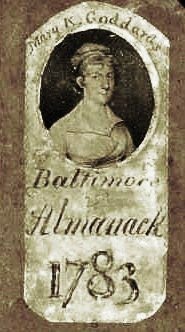
Mary Katherine Goddard's almanacs were also popular in the Chesapeake. In her 1782 Maryland and Virginia Almanack, Mary Katherine wrote, "From the extensive sale of this Almanack last year, the publisher would presume to think that her endeavors, in some measure, met with the approbation of the Public. Nothing can be more flattering than this idea, which cannot fail to excite in her the highest sense of gratitude, attended with future diligence and perseverance."

After he married, her mercurial brother decided that he wanted to return to the Baltimore publishing business and to run the newspaper and the press himself in 1784. He had never been successful at any occupation and was jealous of his sister's success. Wrenching control of the press was not without turmoil. Mary Katherine Goddard filed 5 lawsuits against her brother before severing her interest in the printing enterprise, which she had successfully managed for 10 years. After all, she still had her position as Baltimore's postmistress to rely on for income.

However, in September 1789, Samuel Osgood, the newly appointed national Postmaster General, decided that inexperienced political appointee John White of Baltimore should replace Goddard. The Assistant Postmaster General Jonathan Burrall was dispatched to Baltimore to give Mary Katherine Goddard the news; but unable to face her in person, he sent a note to her office. She was ordered to turn over her office to White, and told, "a younger person able to ride a horse" was needed.

Over 200 merchants & residents in Baltimore sent a petition and letters objecting to her removal to the Postmaster General. They received no reply. Believing she was still capable at age 51; just before Christmas, she wrote to President George Washington to have the order reversed. She wrote the letter in the 3rd person.

Baltimore, Decemr 23d 1789.
Dear Sir,


The Representation of Mary Katherine Goddard, Humbly sheweth--That She hath kept the Post Office at Baltimore for upwards of fourteen years; but with what degree of Satisfaction to all those concerned, She begs leave to refer to the number & respectability of the Persons who have publickly addressed the Post Master General & his Assistant, on the Subject of her late removal from Office; And as Mr Osgood has not yet favoured between two and three hundred of the principal Merchants & Inhabitants of Baltimore with an answer to their last application, transmitted to him by Post on the last Day of November ultimo,
nor with any Answer to sundry private Letters, accompanying the transcript of a like application, made to Mr Burrell when at Baltimore: She therefore, at the instance of the Gentlemen thus pleased to interest themselves on her behalf, lays before your Excellency, Superintendant of that department, as briefly as possible, the nature & circumstances, of what is conceived to be an extraordinary Act of oppression towards her.

That upon the dissolution of the old Government, when from the non importation Agreement and other causes incident to the Revolution, the Revenue of the Post-Office was inadequate to its disbursements, She accepted of the same, and at her own risque, advanced hard money to defray the Charges of Post Riders for many years, when they were not to be procured on any other terms; and that during this period, the whole of her Labour & Industry in establishing the Office was necessarily unrewarded; the Emoluments of which being by no means equal to the then high Rent of an Office, or to the Attention required both to receive & forward the Mails, as will evidently appear by the Schedule, here unto annexed,
and therefore, whoever thus established & continued the Office, at the gloomy period when it was worth no Person's Acceptance, ought surely to be thought worthy of it, when it became more valuable. And as it had been universally understood, that no Person would be removed from Office, under the present Government, unless manifest misconduct appeared, and as no such Charge could possibly be made against her, with the least colour of Justice, She was happy in the Idea of being secured both in her Office, and the Protection of all those who wished well to the prosperity of the Post Office, & the new Government in general.

That She has sustained many heavy losses, well known to the Gentlemen of Baltimore, which swallowed up the Fruits of her Industry, without even extricating her from embarrassment to this day, although her Accounts with the Post Office were always considered, as amongst the most punctual & regular of any upon the Continent; notwithstanding which She has been discharged from her Office, without any imputation of the least fault, and without any previous official notice: The first intimation on that head being an Order from Mr Burrell,
whilst at Baltimore, to deliver up the Office to the Bearer of his Note; and altho' he had been there several days, yet he did not think proper to indulge her with a personal Interview, thus far treating her in the Stile of an unfriendly delinquent, unworthy of common Civility, as well as common Justice. And although Mr White, who succeeded her, might doubtless have been meritorious in the different Offices he sustained, yet, She humbly conceives, he was not more deserving of public notice & protection in his Station, than She has uniformly been in hers: It must therefore become a matter of serious Importance & of peculiar distress to her, if Government can find no means of rewarding this Gentleman's Services, but at the Expence of all that She had to rely on, for her future dependence & subsistence.

That it has been alledged as a Plea for her removal, that the Deputy Post Master of Baltimore will hereafter be obliged to ride & regulate the Offices to the Southward but that She conceives, with great deference to the Post Master General, this is impracticable, & morally impossible; because the business of the Baltimore Office will require his constant Attendance, & he alone could give satisfaction to the people, if therefore the duties of the Assistant, Mr Burrells' Office are to be performed by any other than himself, surely it cannot well be attempted by those who are fully occupied with their own; and as two Persons must be employed, according to this new Plan, She apprehends, that She is more adequate to give Instructions to the Riding Post Master, how to act than any other Person possibly could, heretofore unexperienced in such business.She, therefore, most humbly hopes from your Excellency's Philanthropy and wonted Humanity, You will take her Situation into Consideration; and as the Grievance complained of, has happened whilst the Post Office Department was put under your auspicious Protection, by a Resolve of Congress, that Your Excellency will be graciously pleased to order, that She may be restored to her former Office, and as in duty bound, She will ever pray &c.
Mary K: Goddard


George Washington promply responded.

New York January 6th.1790
Madam,

In reply to your memorial of the 10th of December, which has been received, I can only observe, that I have uniformly avoided interfering with any appointments which do not require my official agency: and the Resolutions and Ordinances establishing the Post Office under the former Congress, and which have been recognized by the present Government, giving power to the Post-Master General to appoint his own Deputies, and making him accountable for their conduct, is an insuperable objection to my taking any part in this matter.

I have directed your Memorial to be laid before the Post-Master General who will take such measures thereon as his Judgment may direct.

I am, Madam. Your Most Obedt. Servt. Go: Washington


Puffing himself up, Postmaster Samuel Osgood responded the next day giving no reason for the appointment of White except the following: "From mature Consideration, I am fully convinced that I shall be more benefitted from the Services of Mr White than I could be from those of Mrs Goddard."

After receiving Washington's dismissive letter, she pressed her appeal for reinstatement & for payment of a claim against the United States in both the Senate and House of Representatives. She was unsuccessful in obtaining either compensation or reinstatment.

The 1790 Maryland Census reported she owned four slaves and had one other free person living in her household. From 1790 to 1802, she operated a bookstore in Baltimore.

By the canvass of the 1810 Maryland Census, Mary Katherine Goddard was living with just one female slave in her household. Mary Katherine died in Baltimore in August of 1816, at the age of 78, leaving all her personal possessions & real property to her African American servant Belinda Starling & releasing her from slavery.
.

Newspaper - 1736 Runaway Woman - Maryland Indentured Servant

.

RAN away, on the 30th of September last, from the City of Annapolis, ...a Servant Woman, named Sarah Miers, a Dutch Woman, and talks broken English, pretty Tall, Round Shoulder'd. Likely in the Face, and had a Flat Nose: They took with them some Wearing Apparel, viz. a dark Grey Coat trimm'd with Black, a Woman's Blue Cloak, fac'd with White Silk; a Seesucker Gown, one White Linen Ditto; one strip'd Calimanco Ditto, a brown Camblet Petticoat, a Woman's Bermuda hat, lin'd with Blue Silk, and several other Things, viz. Bedding, Linnen, and in particular a Red Rugg. They went in an old carvil Work Long-Boat, with one Mast, and a Square Sail.

Virginia Gazette (Parks), Williamsburg, From Friday, October 8, to Friday, October 15, 1736.
.

Jumat, 16 September 2011

Newspaper - 1751 Runaway Love Triangle in Virginia

.

Stafford County, October 13th, 1751. RAN away from the Subscriber, this Day, a Servant Man, anmed William Frye...had on when he went away a bluish grey Kersey Coat, with yellow Buttons...The said Runaway went off with the Wife of the Subscriber, named Mary, a short, thick Woman of a dark Complexion, with black hair, black Eyes, aged about 30 Years, and has lost one of her front Teeth: She is a neat Woman in Sewing, Spinning, and knitting Stockngs, and can do almost any Manner of Taylors Work, but is oblig'd to use Spectacles when at Work. She took with her a striped Silk Stuff Gown...And, as the above-mentioned Mary has eloped from her said Husband, I hereby foreward all Persons from trusting her on my Account, for I will not pay any Debts she shall contract after the Publication hereof.

Virginia Gazette (Hunter), Williamsburg, October 31, 1751.
.

Newspaper - 1777 Army Deserter from the Revolution Runs Away with his Pregnant Wife

.
DESERTED from the 2d Virginia Regiment in New Jersey, the following ...Serjeant, 30 Years of Age...his Wife, who was heavy with Child, went off with him...the Serjeant...enlisted into Captain Alexander's Company, and may be taken in Frederick County, Virginia. ALEXANDER SPOTSWOOD, Col. 2d Virg. Reg.

Virginia Gazette(Dixon & Hunter), Williamsburg , September 5, 1777
.

Kamis, 15 September 2011

Newspaper - Virginia Runaway Slave Seamstresses

.

An unusual number of the slave seamstresses and house slaves appearing in Virginia runaway notices, were mulatto. The seamstresses had a variety of skills; while all were seamstresses, some were also described as being able to spin, weave, wash, and iron. Slaves, who were children of the master or his male relatives, were often raised to work in the house, closer to the family. Perhaps they were more likely to run away, because there was at least a chance that they could pass as white.

Below are slave notices for runaway seamstresses from a survey of most 18th century Virginia newspapers.

Virginia Gazette (Hunter), Williamsburg, October 27, 1752.
RAN away...a fair Mulatto Woman Slave, named Moll, about 22 Years of Age, and 5 Feet high, with brown Hair, grey Eyes, very large Breasts and Limbs two of her upper fore Teeth are rotten and broken off...she is a very sly subtle Wench and a great Lyar; she is very handy about waiting and tending in a House, and can wash, iron and sew coarse Work. It's likely she may change her Name, pass for a free Woman and hire herself...

Virginia Gazette (Purdie & Dixon), Williamsburg, September 8, 1768.
RUN away...a bright mulatto wench called LUCY... She sews and irons well, is about 35 years old, has two moles on one side of her nose, three of her fingers on one hand contracted by a burn when young, and a large scar on one of her elbows...

Virginia Gazette (Purdie & Dixon), Williamsburg, October 20, 1768.
RUN away...a bright mulatto wench named JUDE, about 30 years old, is very remarkable, has lost one eye, but which I have forgot, has long black hair, a large scar on one of her elbows, and several other scars in her face...I have great reason to think she will pass for a free woman, and endeavour to make into South Carolina. She is very knowing about house business, can spin, weave, sew, and iron, well...

Virginia Gazette (Purdie & Dixon), Williamsburg, May 6, 1773.
RUN away...a Country born Negro Woman named SARAH, a very lusty stout made Wench, about two and twenty Years of age, very artful, and, though not a Mulatto, may attempt to pass for a free Woman...She has been chiefly a House Servant, is a fine Sempstress, Knitter, Washer, and Ironer...

Virginia Gazette (Purdie), Williamsburg, February 21, 1777
...reward for taking up and delivering PATTY, a lightish coloured negro woman, pitted with the small pox, about 30 years of age, walks well, and generally fast, is rather above the middle size, well shaped, a good sempstress...

Virginia Gazette (Purdie), Williamsburg, August 8, 1777.
RUN away...a mulatto girl named KATE, or Catharine, about 5 feet high, has been brought up in the house from her infancy, and can work well with a needle. She is 19 or 20 years of age, has a smiling countenance when spoke to, and at some times is rather impertinent...

Virginia Journal and Alexandria Advertiser (Richards), Alexandria, October 21, 1784.
RAN away...CATE, a light Mulatto, about 22 years of age, about 5 feet high, full faced, expressive eyes, of a pleasant countenance, an high forehead, fine teeth, bushy long hair, is well set, and broad shouldered...She is very handy, spins well, and has been used to both house and plantation work. SINAH, about 20 years of age, rather of a darker complexion than Cate, has a sunken bumpy face, a very unbidding look, has a decay and holes in two of her upper foreteeth, a sulky illnatured countenance, well shaped, of the middle size, low forehead, and very bushy long hair...She has been brought up in the house, is a good seamstress, and spins well...

Virginia Journal and Alexandria Advertiser (Richards), Alexandria, September 29, 1785.
RAN AWAY...a MULATTO WOMAN, named MOLLY; of a middle size...As she can read, and is handy at her needle, it is probable she will endeavour to pass for a free woman. She is very artful, and capable of inventing a falsehood...

Virginia Independent Chronicle (Davis), Richmond, July 9, 1788.
RUN-AWAY ...a likely MULATTO WOMAN, called RACHEL; about 25 years of age, 5 feet 2 or 3 inches high, thin visage, long black hair, stoops in the shoulders, and has a scar (not very visible) on her chin, occasioned by the kick of a horse when a child. She is an excellent sempstress, and it is probable will pass (from being uncommonly white) for a free woman, unless closely observed...

Virginia Independent Chronicle (Davis), Richmond, March 13, 1790
.... a low, black, well set wench for a wife, the property of a Mr. James Toolers of Charles City, the wench is a decent house servant, can sew and wash very well

Virginia Gazette and General Advertiser
(Davis), Richmond, January 26, 1791
....She is about 40 years of age, and rather above the common stature, has a scar upon the back of her neck, and is a pretty good sempstress...

Virginia Gazette and General Advertiser (Davis), Richmond, January 18, 1792.
Committed to the jail of this county...a runaway negro wench who calls herself JAMIMAH, and says she belongs to a Mr. Robert Thompson of Louisa county. She appears to be about twenty years of age, very likely in person, above the middle size, strong, straight, of a very healthy and vigorous carriage, and remarkably handy in a family. She can sew plain work very well, is of a kind, obliging, obedient, soft disposition, with many marks on her back of having been severely and cruelly whipped indeed.

Norfolk Herald (Willett and O'Connor), Norfolk, May 13, 1797
....SLAVES left my residence...JAMES, A Mullato Man, about 30 years of age, ...The other slave is a dark mulatto woman called KESIAH, Wife to the above described man. She is a thin delicately formed woman, rather small, has short hair, with several grey bunches just appearing from under her cap on the from part of her head---her teeth before are decayed---She is much addicted to smoking tobacco, and is a great drunkard---She is between 30 and 40 years of age...Both these people have been bred to domestic capacities; the man is a house servant and to wait on a gentleman when travelling; the woman a lady's maid, and an excellent sempstress...

Alexandria Advertiser and Commercial Intelligencer (S. Snowden & Co.), Alexandria, May 7, 1802
....Ran Away...Patty, a likely Negro wench, about twenty years of age: she has been brought up in the house, is a good seamstress, & very capable...

Norfolk Herald (Willett and O'Connor), Norfolk, June 28, 1803
...eloped from me in August last. LUCY is about 40 years of age; rather spare made, has large eyes, and of a dark tawney complexion; I am told she can read, and perhaps write a little. She is an excellent seamstress, nurse &c...
.

Rabu, 14 September 2011

Newspaper - Runaway Slaves Who Could Read & Write

.

Virginia Journal and Alexandria Advertiser (Richards), Alexandria, September 29, 1785.
RAN AWAY...a MULATTO WOMAN, named MOLLY; of a middle size. She took with her two Virginia cloth jackets and petticoats, one brown and one green baize ditto, with sundry other things.---As she can read, and is handy at her needle, it is probable she will endeavour to pass for a free woman.

Virginia Gazette and General Advertiser (Davis), Richmond, August 24, 1791.
The following NEGROES...A MULATTO WOMAN went off with the above, who has since been been taken up at Norfolk, and as she can write, she probably has furnished the others with passes, changing thier name.

The Herald and Norfolk and Portsmouth Advertiser (Willett and O'Connor), Norfolk, November 9, 1795.
RUN AWAY...A likely mulatto woman named SILLAR, about the common stature, 25 years of age, and walks generally very brisk; she has been brought up a House Servant and can read a Letter...it is expected as she carried off her bed, bedding, and a number of good clothes, that she as been coaxed away by some free Negro or other, who has conveyed her off by water and intends to pass her as a free woman

Norfolk Herald (Willett and O'Connor), Norfolk, September 14, 1797.
Run away Negroes...JACK, a Carpenter by trade, about 40 years of age, 5 feet 9 or 10 inches high, of a dark complexion. PHEBE, his wife, and his daughter BETSEY, about 16 years of age, a very likely wench; also Two of the said Phebe's Children, one of which is 5 or 6 years and the other 6 months old. It is suspected Jack's wife will forge passes as she is very artful and can write...A Negro Fellow named Joe, son to the above Jack, about 20 years of age, plays on the Violin.

Norfolk Herald (Willett and O'Connor), Norfolk, October 2, 1800.
Negro Girl named NANCY, about 19 years of age, about 4 feet 4 inches, good stout looking girl; her complexion paler than general; had on when she went away a black new fashioned paste-board bonnet, trimmed with black ribbon, a blue handkerchief on her neck, dark callico short gown, purple worsted petticoat, she had a sifter in which she had cakes to sell about town...She has changed her name to BETSEY. Speaks very good Dutch, can read and write, and may forge herself a passport.

Norfolk Herald (Willett and O'Connor),Norfolk, October 29, 1801.
Forty Dollars Reward. RAN-AWAY from the subscriber, living in Petersburg, Virginia, in the afternoon of Thursday, the 22d inst. a likely spare made Negro Woman, named LUCINDA, (but sometimes she is called Lucinda Walker, and at other times Lucinda Brown) about 24 years of age, she is of the common height, and rather black: she has a remarkable pleasant countenance, smooth insinuating manners, and speaks very correct and distinct--she had previously sent off the most of her clothes in a trunk, (supposed marked at the bottom W.D. or W.I.D.) of which she has a variety of good materials and well made. I am informed she had made up just before her elopemont, a habit and coat of dark blue cloth in the fashion; and it is likely she will travel in that dress--she can both read and write a little: I am pretty certain that she has been enticed off by some bad designing man, probably white, and that she has through them procured free papers, or a pass of some kind which she will make use of. She was born and brought up in the family indulgently...expressing a desire to go to Europe.
.

Senin, 12 September 2011

Newspaper - Runaway House Slaves

.


Maryland Journal and Baltimore Advertiser (Goddard), Baltimore, June 27, 1780.
NEGROES, who ran away...Lucy, Hannah, and Nan...They are most of them very artful, and expect to pass as free people...Lucy's business has been to wash and iron. Young Hannah and Nan are exceeding good flax spinners. They are all mostly cloathed in Virginia cloth...They have stole some guns, and many different sorts of clothes, and I expect they will change their names.

Virginia Gazette (Clarkson & Davis), Richmond, August 19, 1780.
RUN away...a young mulatto wench named Sukey. Her dress when she went away was white Virginia cloth, a linen bonnet made in the fashion; she has a large bushy head of hair, her upper fore teeth much decayed, and some of them out, which causes her to lisp, shows her teeth when laughing, and is very brazen and impertinent. She can wash, iron, and cook.

Virginia Gazette and General Advertiser (Davis), Richmond, January 26, 1791.
RAN-AWAY...a large fat likely negro woman, known by the name of SARAH, but looks young to her age, which is between 40 or 50, of a bold insinuating countenance, artful and cunning to the highest degree...She is an excellent house servant, as to spinning cotton of flax, sewing, knitting, cooking, washing, or any thing else a wench can do, and can work very well in the crop--She is fond of making and selling ginger bread, &c. ...Her clothing when she went away was a large scarlet frize cloak, a hat dress with white ribbon and buckle, one callico jackcoat, one suit of green durants, sundry suits of strip'd and white Virginia cloth, and wore two silver rings on her fingers.

Virginia Herald and Fredericksburg Advertiser (Green), Fredericksburg, November 14, 1793.
RAN AWAY...in Orange county, the last of September, NEGRO MOLLY, a lusty likely woman, about 41 or 42 years of age, rather dark complexion; she is a healthy, neat, industrious wench, a good cook, washer and ironer, and is well acquainted with house business

American Gazette and Norfolk and Portsmouth Public Advertiser
(Davis), Norfolk, September 15, 1795.
RUN AWAY this morning, a negro Woman named MOLLY, But has of late gone by the name of BETTY...She is very black, has a bushy head, and remarkable white teeth, is about 5 feet 9 or 10 inches high, and supposed to be about 36 years of age; is a very good washer and ironer, and am informed a good cook, and is well acquainted with all kind of house business.

Norfolk Herald (Willett and O'Connor), Norfolk, August 2, 1800.
Negro Woman named PATTY...about 28 years of age, thick, well set, and about 5 feet 5 inches high. She has short curled hair, and prominent features, particularly eyes, noes, and mouth. Her teeth are bad and yellow, and the whites of her eyes are much affected by smoke. On her shoulders are two scars visible when she does not wear a handkerchief; and her right arm shews the marks of very frequent bleeding. Her voice is rather shrill; she is very talkative and disposed to be impertinent; but when it suits her purpose can assume every appearance of perfect humility. I expect she is in Norfolk, in company with a sister who bears a very striking resemblance...Patty is a good cook and washer, and probably will practice one or the other for a livelihood.

Norfolk Herald (Willett and O'Connor), Norfolk, March 12, 1801.
Run-a-way...Negro SAREY...well known in Norfolk as a negro hiring herself out to day's work at washing

Norfolk Herald (Willett and O'Connor), Norfolk, July 6, 1802
Ran Away...a tall, spare black woman named POLLY, about 20 years old, formerly the property of Major Roger West: she has been brought up to house-work, is a good cook, washer and nurse.

Sabtu, 10 September 2011

Newspaper - Runaway Slaves - Carders, Spinners, Weavers, & Knitters

.


Virginia Gazette (Hunter), Williamsburg, November 7, 1754.
RAN away...a Mulatto Wench, named Molly, about 26 Years of Age, of a middle Stature, long Visage, and freckled, has a drawling Speech, a down Look, and has been chiefly brought up to Carding and Spinning.

Virginia Gazette (Dixon & Hunter),Williamsburg, March 11, 1775.
RUN away... a very bright Mulatto Man named STEPHEN, 5 Feet 6 or 7 Inches high, about 22 Years of Age...His Wife PHEBE went away with him, a remarkable white Indian Woman, about the same Age, and was with Child; she has long black Hair, which is generally clubbed, and carried off with her a blue Negro Cotton Waistcoat and Petticoat, a Virginia Cloth Waistcoat and Petticoat, and a Virginia Cloth Bonnet. She can spin well...

Virginia Gazette or American Advertiser (Hayes), Richmond, February 2, 1782.
A black fellow by the name of PETER, frequently called PETER WOOD, about 37 or 38 years of age, 5 feet 8 or 9 inches high, has a smiling countenance...Also a very likely black girl, wife to the above fellow and taken off by him, about 18 or 19 years old, middle size, by the name of AMIA...She is a fine spinner and Weaver, has never had a child, and I am informed has holes in her ears for rings.Virginia Gazette or Weekly Advertiser (Nicolson & Prentis), Richmond, May 11, 1782.
VIOLET, went off about eight weeks ago, and is now harboured in Williamsburg, about twenty two years old, very likely, genteel made, and knits very well.

Virginia Gazette and Weekly Advertiser
(Nicolson & Prentis), Richmond, November 22, 1783.
RUN away...a negro girl named PHILLIS, but for some time passed by the name BETTY. She is about sixteen years of age, an excellent spinner, and very likely...She has for some time been harboured about Rocket's, and is very intimate and supposed lives with one Free Harry.

Virginia Gazette or American Advertiser (Hayes), Richmond, October 16, 1784.
RAN AWAY...a likely Mulatto woman named CHARITY, who carried with her three children, two boys and a girl...She is a likely wench, has an uncommon good voice, is a good house servant, and can spin and knit very well.

Virginia Gazette or American Advertiser (Hayes), Richmond, December 31, 1785
....my negro woman TABB. She is of a middle stature, rather of a yellowish cast, and thin visage, straight made, walks and talks quick...When she went off, she was clothed as Negroes generally are, which she will certainly change, being very fond of dress, and looks tolerable genteel. She is remarkable handy and industrious, can card and spin cotton and wool, equal in quantity and quality with any woman in the State; a tolerable good weaver, which she followed when she runaway before, and changed her name to Nancy Jones.

Virginia Gazette and Weekly Advertiser (Nicolson), Richmond, April 17, 1788.
RUN away...a stout well made Virginia born negro woman, named DINAH, but has changed her name to NANCY, her complexion is rather of the tawny kind, she has a scar on her forehead, and keeps her eyes rather closed when speaking, she chews tobacco, and smoaks...She last hired herself to Mrs. Jones, at Spring Garden, in Hanover, for a spinner and weaver, and had one of the house servants for her husband...

Virginia Gazette and General Advertiser (Davis), Richmond, January 18, 1792.
Run away...a likely negro woman, named URSULA, of a yellowish complexion, with some black moles on her face, 30 years of age, 5 feet three or 4 inches high, had on, when she went away, such cloathing as negroes generally wear in the summer, and carried with her a white linen coat and jacket. She is a vile creature, and for her many crimes I punsihed her with an iron collar, but supposed she soon got that off. She is very artful, has a smooth tongue, and is a good weaver, and as she has for some time imposed on the Baptist church by her pretensions to religion, she may probably attempt to pass for a free woman, and do the same again.
.

Rabu, 08 Juni 2011

1784 Abigail Adam's Letter about French Women

.
Benjamin Blythe Portrait of Abigail Smith Adams 1766

39 year-old Abigail Adams to 17 year-old Lucy Cranch
Sunday, 5 September 1784

Written from
Auteuil, Paris, Ville de Paris, Île-de-France, France

…This lady (Mme Helvétius) I dined with at Dr. Franklin's. She entered the room with a careless, jaunty air; upon seeing ladies who were strangers to her, she bawled out: “Ah! mon Dieu, where is Franklin? Why did you not tell me there were ladies here?” You must suppose her speaking all this in French. “How I look!” said she, taking hold of a chemise made of tiffany, which she had on over a blue lute-string4, and which looked as much upon the decay as her beauty, for she was once a handsome woman; her hair was frizzled; over it she had a small straw hat, with a dirty gauze half-handkerchief round it, and a bit of dirtier gauze, than ever my maids wore, was bowed on behind. She had a black gauze scarf thrown over her shoulders. She ran out of the room; when she returned, the Doctor entered at one door, she at the other; upon which she ran forward to him, caught him by the hand: “Hélas! Franklin;” then gave him a double kiss, one upon each cheek, and another upon his forehead. When he went into the room to dine, she was placed between the Doctor and Mr. Adams. She carried on the chief of the conversation at dinner, frequently locking her hand into the Doctor's, and sometimes spreading her arms upon the backs of both the gentlemen's chairs, then throwing her arm carelesly upon the Doctor's neck.


I should have been greatly astonished at this conduct if the good Doctor had not told me that in this lady I should see a genuine Frenchwoman, wholly free from affectation or stiffness of behaviour, and one of the best women in the world. For this I must take the Doctor's word, but I should have set her down for a very bad one, although sixty years of age, and a widow. I own I was highly disgusted, and never wish for an acquaintance with any ladies of this cast. After dinner she threw herself upon a settee, where she showed more than her feet. She had a little lap-dog6, who was, next to the Doctor, her favorite. This she kissed, and when he wet the floor she wiped it up with her chemise. This is one of the Doctor's most intimate friends, with whom he dines once every week, and she with him. She is rich, and is my near neighbour, but I have not yet visited her. Thus you see, my dear, that manners differ exceedingly in different countries. I hope, however, to find amongst the French ladies manners more consistent with my ideas of decency, or I shall be a mere recluse...

Abigail Smith Adams was the daughter of Rev. William Smith (1707–1783) and his wife, Elizabeth née Quincy; in 1764 she married John Adams then a lawyer and later the second president of the United States; they had five children, including John Quincy Adams (1767–1848), who also became president of the United States. On her husband's election as president she became the first hostess to use the White House (unfinished until 1800). A strong advocate of women's rights and opponent to slavery; she died a few days before her son became president.

Lucy Cranch was the daughter of Richard Cranch (1726–1811), a manufacturer, and his wife, Mary née Smith (1741–1811), sister of Abigail Adams. In 1791 she married her cousin John Greenleaf (1763–1848), a blind musician; they had seven children.
.

Popular Posts